Saturday, 20 July 2019

Can planting trees save our climate?

In recent weeks, a new study by researchers at ETH Zurich has hit the headlines worldwide (Bastin et al. 2019). It is about trees. The researchers asked themselves the question: how much carbon could we store if we planted trees everywhere in the world where the land is not already used for agriculture or cities? Since the leaves of trees extract carbon in the form of carbon dioxide – CO2 – from the air and then release the oxygen – O2 – again, this is a great climate protection measure. The researchers estimated 200 billion tons of carbon could be stored in this way – provided we plant over a trillion trees.

The media impact of the new study was mainly based on the statement in the ETH press release that planting trees could offset two thirds of the man-made CO2 increase in the atmosphere to date. To be able to largely compensate for the consequences of more than two centuries of industrial development with such a simple and hardly controversial measure – that sounds like a dream! And it was immediately welcomed by those who still dream of climate mitigation that doesn’t hurt anyone.

Unfortunately, it’s also too good to be true. 

Read the RealClimate article

Wednesday, 17 July 2019

Video: Is Miami Beach Drowning?


CBC News: The National

Published on Oct 16, 2014

The Union of Concerned Scientists is warning climate change is raising sea levels and the panel predicts Miami faces being swamped.

Sunday, 14 July 2019

The ‘Historical Jigsaw of Climate Deception’: Private Notes Show How Big Oil Spread Climate Science Denial: DESMOG

EXXON & climate change
We’ve all heard the dodgy arguments: ‘the science is uncertain’, ‘climate change is natural, not down to humans’, ‘science has been hijacked by politics’… Now a new cache of documents sheds light on the origins of the disinformation.  

In another verse of a now familiar refrain, a fossil fuel industry group in the 1990s publicly promoted arguments to undermine confidence in climate science while internally acknowledging their products were driving up temperatures.  

A cache of meeting minutes, briefings, and emails uncovered by the Climate Investigations Center shows how industry group the Global Climate Coalition (GCC) used its financial clout and political connections to cast doubt on mainstream climate science until its disbandment in 2002. The GCC would for decades cast doubt on the veracity of climate science and strategically spread the message that the UN Intergovernmental Panel on Climate Change (IPCC) was a politicised body, to discourage regulatory reform that would hit coalition members’ profits. 

Friday, 12 July 2019

What will an Earth that is 4 degrees hotter be like?


Earth at 2° hotter will be horrific. Now here’s what 4° will look like. | David Wallace-Wells author of The Uninhabitable Earth.

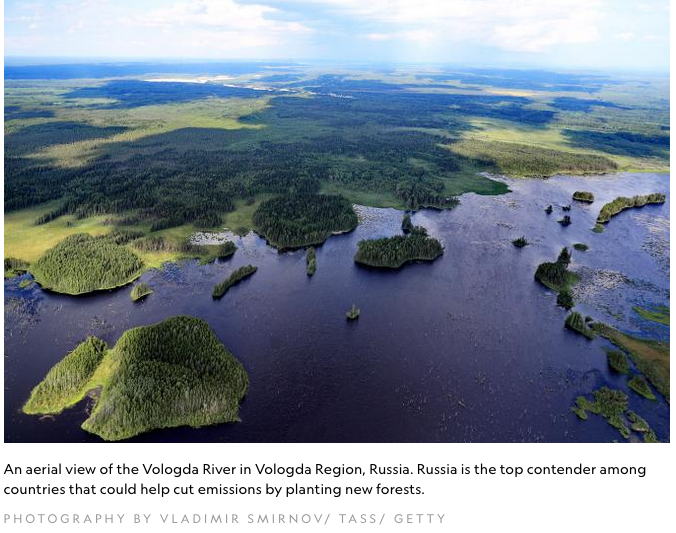
How to erase 100 years of carbon emissions? Plant trees—lots of them.

Increasing the Earth’s forests by an area the size of the United States would cut atmospheric carbon dioxide 25 percent.

 PUBLISHED


An area the size of the United States could be restored as forests with the potential of erasing nearly 100 years of carbon emissions, according to the first ever study to determine how many trees the Earth could support.
Published today in Science, "The global tree restoration potential” report found that there is enough suitable land to increase the world’s forest cover by one-third without affecting existing cities or agriculture. However, the amount of suitable land area diminishes as global temperatures rise. Even if global warming is limited to 1.5 degrees Celsius, the area available for forest restoration could be reduced by a fifth by 2050 because it would be too warm for some tropical forests.
“Our study shows clearly that forest restoration is the best climate change solution available today,” said Tom Crowther, a researcher at ETH Zürich, and senior author of the study.


Thursday, 11 July 2019

6 Glimmers of Climate Optimism for the End of a Dark Year: Medium

It was a year of frightening reports on the future of our planet. But sustainability experts are still feeling optimistic about some of the strides we’ve made this year.

The consensus among scientists, researchers, and sustainability experts following this years’ reports is that while stopping climate change will require an undoubtedly Herculean effort, the biggest hurdle is political, not technical. In other words, if all the innovations in sustainable technology and science were harnessed and directed at reducing emissions and environmental collapse, we might stand a chance at meeting the goals laid out in the reports.

Don’t get us wrong: It will take a heroic, global effort if we’re even going to come close to limiting global warming to 1.5 degrees Celsius–the point after which, according to the reports, large swaths of the planet will become uninhabitable, and issues like mass starvation will become widespread. And the lack of leadership from the United States, under climate change denier Donald Trump, is making cohesive political action difficult.

But underneath all this, activists, scientists, and business leaders are
working to advance progressive climate action, and despite everything, have hung onto a sense of optimism as we move into 2019. Here are some reasons why:"


Related:

Restoring forests may be one of our most powerful weapons in fighting climate change: Vox


Wednesday, 10 July 2019

Fossil fuel exports make Australia one of the worst contributors to climate crisis : The Guardian

Australia looking to become an emissions superpower, the Australian Conservation Foundation says

Australia is responsible for 5% of global greenhouse gas emissions and could be contributing as much as 17% by 2030 if the pollution from its fossil fuel exports is factored in, research says.

Under climate accounting rules that record carbon dioxide released within a country, Australia is responsible for about 1.4% of global emissions. The analysis by science and policy institute Climate Analytics found more than twice that, another 3.6%, are a result of Australia’s coal, oil and gas exports.