Sunday, 6 September 2020

Germany's coastal lowlands under the shadow of climate change: DW

predicted sea level rise
German mud flats in danger
"Much of Germany's North Sea coast is low enough to put it at risk from the waters at its door. Not least in an era of warming temperatures and predicted sea level rise."

"The wind whips threatening clouds across a dark blue sky above the North Frisian island of Pellworm. Petra Feldkamp casts a glance toward a high green dike in the near distance. Directly behind it, the sea rolls and roars. Out of sight, but not out of mind.

Particularly after a summer in which the realities of our warming global climate have been scorched into the German consciousness.
"I think we all take it seriously. When you live here, you see the situation, you feel it," says Feldkamp, whose family has been on the island for generations. "But this is a place of calm, so it doesn't really scare you."

Though she acknowledges that her sense of calm is in large part due to the protective dikes that were recently raised, and without which the island "would drown," she says she feels "totally safe."
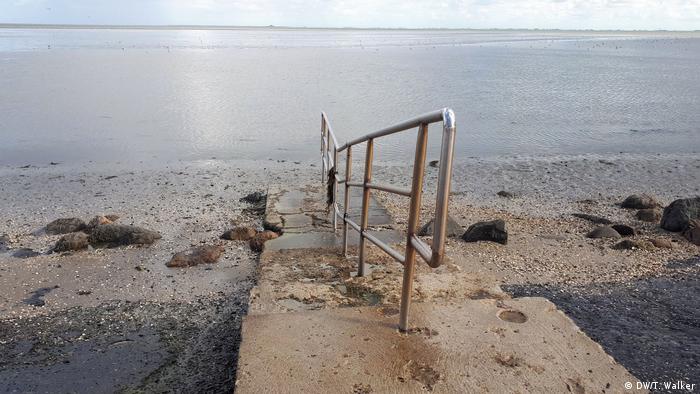
A railing and steps lead down to a calm sea (DW/T. Walker)
When the sea is calm, so is the sense of living alongside it.
For Thomas Langmaack of the northern state of Schleswig-Holstein's agency for coastal defense, national parks and marine conservation (LKN), that's a cause for concern.


Too close yet too comfortable

It is also his job to foster an understanding among communities inhabiting the 3,900 square kilometers (1,505 square miles) of lowland — some of which was originally sea snared over time through the construction of dikes — of the capricious and sometimes ferocious nature of the waters that swirl around them.

"People have largely become careless," Langmaack said. "They've suppressed it, because there hasn't been a devastating storm surge for several decades."

And because the several hundred kilometers of complex dikes form a wall between them and the sea, they are safer than ever before.
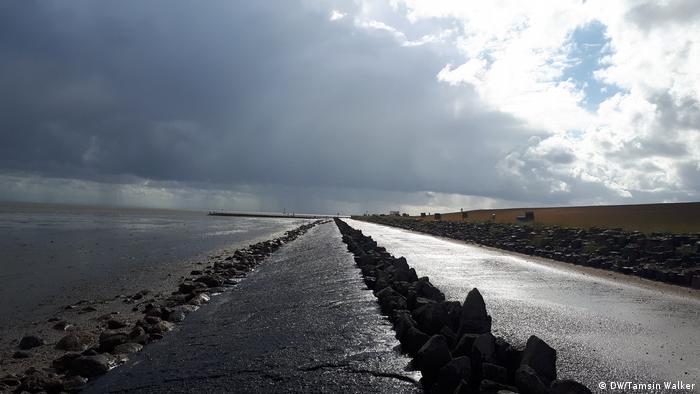
predicted sea level rise
Dikes are constantly being repaired and renewed

Dikes are constantly being repaired and renewed to enable the people to continue to live in the flatlands in relative safety
"But even they can fail," LKN spokesman Hendrik Brunkhorst said. "We have to make people aware of the dangers."

The sea rose only 28 centimeters (11 inches) between 1940 and 2007, which is in keeping with recordings from the previous century. But there is a sense of urgency about the need to prepare local communities for the worst, in part stirred by cyclone Xaver, which hit the region in 2013, but also because both sea and storm water levels are predicted to rise within the coming decades.

Planning for the unknown

Besides alerting the population, the agency for coastal defense has been strengthening its fortifications with so-called "climate dikes."

A far cry from the early hand-built clay incarnations that began appearing on the flat northern German landscape around a millennium ago, these precision-engineered giant green slopes are designed to keep the waves at bay in such a way that it would be easy to add a new layer on top if water levels were to suddenly rise much faster than current forecasts suggest.

"We have to look to the future," Langmaack said. "What we have is rising temperatures, and that means rising sea levels, but nobody can tell us how the curve is going to develop, and that makes it very difficult."

"We're genuinely planning for the next 100 years," he continued."

.......................

"As a conservationist, Fröhlich doesn't generally sanction the idea of tampering with nature, but climate change  induced sea level rise could, he says, be grounds enough for an exception.

"I think we underestimate what's around the corner," he said. "I'm worried that large parts of this area will be lost. I really am."

And if that happens, if the Wadden Sea starts to swallow itself, there's a very good chance the sense of calm it instills in those who live with and from it, will sink as well."

Go to the original, complete, 2018 DW article

Ref: Sea Level Rise and Implications for Low-Lying Islands, Coasts and Communities: IPCC

Related:  Related: East Antarctic Melting Hotspot Identified by Japanese Expedition – Ice Melting at Surprisingly Fast Rate: SciTechDaily

Donald Trump is hampering fight against climate change, WEF warns (excerpt) : The Guardian (2 years ago)

Donald Trump’s go-it-alone approach to tackling climate change
Trump digs coal
Two years after 2018 the situation is even worse.

"World Economic Forum outlines huge increase in all five eco risks since the US president assumed office


The World Economic Forum delivered a strong warning about Donald Trump’s go-it-alone approach to tackling climate change as it highlighted the growing threat of environmental collapse in its annual assessment of the risks facing the international community."

............." the WEF avoided mentioning Trump by name but said “nation-state unilateralism” would make it harder to tackle global warming and ecological damage.

The WEF’s global risks perception survey showed Trump’s arrival in the White House in 2017 had coincided with a marked increase in concern about the environment among experts polled by the Swiss-based organisation.

It said all five environmental risks covered by the survey – extreme weather events, natural disasters, failure of climate-change mitigation and adaptation, biodiversity loss and ecosystem collapse, and human-made natural disasters – had become more prominent.

“This follows a year characterised by high-impact hurricanes, extreme temperatures and the first rise in CO2 emissions for four years. We have been pushing our planet to the brink and the damage is becoming increasingly clear. 

“Biodiversity is being lost at mass-extinction rates, agricultural systems are under strain, and pollution of the air and sea has become an increasingly pressing threat to human health.”


Trump has threatened to withdraw the US from the 2015 Paris agreement under which nations agreed to take steps to limit the increase in global temperature. He has said the commitments made by his predecessor, Barack Obama, would damage the American economy.

Other states have said they will keep to the pledges made in Paris, an approach supported by the WEF."


ALSO

Trump suggests the climate may actually be 'fabulous' after an ominous UN report on looming disaster

failure of climate-change mitigation and adaptationTrump digs coal

  
   • President Donald Trump on Tuesday sought to cast doubt on a UN report on climate change that had dire warnings about how little time we have to stop a global catastrophe.
 
   • Trump suggested that the world’s climate might actually be “fabulous” and that he’d seen reports expressing that position.
 
   • The UN report outlines the effects of global warming of 1.5 degrees Celsius above pre-industrial levels.
 
   • Trump has previously called climate change a “hoax,” and last year he announced he would pull the US out of the Paris climate accord.
Trump, WEF, Paris Agreement, #climate crisis, #jailclimatecriminals, #criminales-climáticos-de-la-cárcel, #criminalesclimáticosdelacárcel, #extremeheat, #icemelting, hurricanes,  climatechangedenial

Saturday, 5 September 2020

'The Future We Choose', Book by Christiana Figueres & Tom Rivett-Carnac

The defining book on the climate crisis that shows us how we can and will survive. 

'The Paris Agreement was a landmark for humanity. In this timely and important book, two of the principle creators of that agreement show us why and how we can now realise its' promise. I hope it is widely read and acted on.' - Jane Goodall, PhD, DBE, Founder of the Jane Goodall Institute and UN Messenger of Peace

The Future We Choose is a passionate call to arms, written by former UN Secretary for Climate Christiana Figures and Tom Rivett-Carnac, her UN political strategist. They outline two scenarios for our future: how life on Earth will be by 2050 if we fail to meet the Paris Agreement climate targets; or how it will look and feel to live in a carbon neutral, regenerative world. Each of us must confront the crisis head on, with determination and optimism.

Practical and empowering, The Future We Choose features ten things we can do today to make a difference. The Future We Choose is for all of us, teenagers to adults, who feel powerless to stop the climate emergency.

This is the final hour: it can be our finest hour. We can solve our climate emergency, but we must act now.


The Future We Choose: Surviving the Climate Crisis Paperback – 3 March 2020 

Amazon: $19.00


'I strongly recommend this enlightening book! The next few years are the most important in humanity's fight to solve the climate crisis. In The Future We Choose, Christiana and Tom show us what's to come, how to face it, and what can be done to make the right choice to save our planet for future generations.' - Al Gore


Paris Agreement, #climate crisis, climate targets, climate emergency, book, #jailclimatecriminals,

Related: A bit rich: business groups want urgent climate action, after resisting it for 30 years (excerpt): The Conversation


PREVIEW: Click to see.


How climate change feeds off itself and gets even worse: Axios

(Pics by this blog)
It takes global cooperation to address climate change,
We want climate action now.

Climate change is like a snowball effect, except, well, hot. 

Why it matters: Like a snowball begins small and grows larger by building upon itself, numerous feedback loops embedded in our atmosphere and society are exacerbating climate change.

Driving the news: Scientists are well acquainted with feedback loops, but the often wonky topic doesn’t break through into the mainstream despite its importance to how much the world warms and how much we respond to that warming.
  • As we soak up the last of these hot summer days, and extreme weather hits parts of the country, today seems a fitting time to break this down for those of us without a Ph.D.
Here are seven feedback loops in science and beyond.
Air conditioning
How it works: Climate change is making our summers hotter, so we use more air conditioners, which emit greenhouse gases, which heats up our planet more, so we use even more AC, which heats up our planet even more ... You get the cycle.

* This is an easy-to-understand feedback loop, but it’s not going to
It takes global cooperation to address climate change,
Heatwaves will kill.
have a big impact on our emissions, says Zeke Hausfather, a climate scientist at the research group Breakthrough Institute. 


* The bigger impact is likely to be population growth in developing countries in hot parts of the world, like India, getting AC to survive their ever-hotter weather.

Water evaporation
This one’s more technical but far more consequential for Earth’s temperature than the AC example.

How it works: The atmosphere heats up as we emit heat-trapping greenhouse gases.

* This warmer air leads to more water evaporation from water 
 “Those decomposition processes emit greenhouse gases,” Duffy said.

* Scientists estimate that there's twice as much carbon locked up in permafrost as is already in the atmosphere, Duffy says. "The potential to amplify warming is huge.”
It takes global cooperation to address climate change,
Melting Land Icesheets
Albedo feedback
This is similar to permafrost. It’s why you feel hotter in black clothes compared to white clothes.
How it works: Lighter surfaces reflect heat more, so as ice and other cold places get warmer (i.e., the Arctic and other permafrost), their ability to reflect heat diminishes and they soak up more heat.
  • “As the world warms, expect a lot of ice and snow to melt, which uncovers darker surfaces, which will result in more warming,” said Hausfather.
Between the lines: This phenomenon, combined with the permafrost one, helps explain why the planet's poles warm faster than the rest of the world.
Wildfires
How it works: Trees, by definition, embody carbon. So when
It takes global cooperation to address climate change,
Californian Wildfires
wildfires burn them down, carbon dioxide is emitted. 


* As the world warms, temperatures get hotter and places get drier, creating tinderboxes for when wildfires do start.
* The hotter the world gets, the bigger wildfires will be (in some places like California), the more CO2 emitted into the atmosphere, which heats up the world more, which will exacerbate wildfires more ...
Policy and economic paralysis
Unlike most policy challenges, climate change gets worse the longer we take to address it.

How it works: The longer we wait to address climate change with major government action, the bigger the policy needed and the bigger economic impact that policy will have.
  • But the bigger the policy and economic hit get, the harder the politics get.
  • So we wait longer still, making the required policy and economic impact ever bigger, which makes the politics even more difficult.
Yes, but: Plausible future scenarios also exist where the impacts of a warming world grow so intense and/or clean-energy technologies become so cheap that eventually these aforementioned feedback loops are broken.
Geopolitics
It takes global cooperation to address climate change,
Carbon tariffs require geopolitical agreements.
How it works: It takes global cooperation to address climate change, given its global nature. But climate change impacts different countries differently, so they're more likely to act on their own, and in their own self-interest.
  • But if there's no global cooperation, climate change continues to get worse — prolonging the adverse impacts on different countries, and giving them even less incentive to cooperate with other countries and more incentive to act on their own.
The bottom line:
“The possible scenario that is a real nightmare is if we don’t control human emissions, nature takes over and we lose control of the warming, because of these emissions from natural systems.”
— Philip Duffy, climate scientist


Go to Axios

Related: East Antarctic Melting Hotspot Identified by Japanese Expedition – Ice Melting at Surprisingly Fast Rate: SciTechDaily


airconditioning, carbon tariffs, feedback loops, tipping points, permafrost, polar ice melt, #jailclimatecriminals, 

A bit rich: business groups want urgent climate action, after resisting it for 30 years (excerpt): The Conversation

There is no systemic government response (federal, state and local) to build resilience to climate risks.
Renewable Energy
"Australia has seen the latest extraordinary twist in its climate soap opera. An alliance of business and environment groups declared the nation is “woefully unprepared” for climate change and urgent action is needed. 

And yesterday, Australian Industry Group – one of the alliance members – called on the federal government to spend at least A$3.3 billion on renewable energy over the next decade. 


Read more: The too hard basket: a short history of Australia's aborted climate policies


There is no systemic government response (federal, state and local) to build resilience to climate risks.
Bushfire readiness
The alliance, known as the Australian Climate Roundtable, formed   in 2015. It comprises ten business and environmental bodies, including the Business Council of Australia, National Farmers

Federation and the Australian Council of Trade Unions (ACTU).
Last week, the group stated

There is no systemic government response (federal, state and local) to build resilience to climate risks. Action is piecemeal; uncoordinated; does not engage business, private sector investment, unions, workers in affected industries, community sector and communities; and does not match the scale of the threat climate change represents to the Australian economy, environment and society.
There is no systemic government response (federal, state and local) to build resilience to climate risks.
Drought
This is ironic, since many of the statement’s signatories spent decades fiercely resisting moves towards sane climate policy. Let’s look back at a few pivotal moments."

Read the complete The Conversation article 


There is no systemic government response (federal, state and local) to build resilience to climate risks.
Youth want

 Related:  Will predicted sea rise inundation affect property values in Newcastle, NSW?
#climateaction, #climatecrisis, #bushfires, economic impact, government response, #jailclimatecriminals

Choosing A Place To Retire? Factor In Climate Change (excerpt): Forbes


The hazards of wildfires and extreme heat are also intensifying due to climate change.
Hurricane damage
(Pics added by this blog)

"When Bill and Annemarie Kachur retired in early 2016, they saw no reason to go anywhere. The gray shingled bungalow in Myrtle Beach, S.C. had been their home for more than 15 years.

“I’ve been here so long, it’s a sense of roots now for me,” says Bill, 65, who spent his early career hopping around the country, working on-air at various radio stations. 

Plus, they were already in a haven for retirees. “I like the fact that there isn’t a winter,” says Annemarie, who’ll be 65 in September.
But in recent years, their idyllic spot about 2 ½ miles from the Atlantic Ocean has revealed an ominous side: hurricane season. “I just noticed that the last four or five years, we keep getting hammered,” recalls Bill.

Two Hurricane Evacuations Since 2016

Since 2016, the Kachurs have ridden out four hurricanes, including two evacuations to safer ground.

“Ten months out of the year, it’s great,” says Bill. “And then there’s a couple months out of the year when you’re walking on eggshells and you’re a little bit concerned about what’s blowin’ in the wind, so to speak.” 

Warm, beachy spots on the Atlantic, Pacific and Gulf Coasts have been retirement magnets for decades. But, as Hurricane Laura just underscored, they’re also squarely in the crosshairs of the changing climate, effects of which are already evident in many of the nation’s most popular retirement destinations.

The hazards of wildfires and extreme heat are also intensifying due to climate change.
Planned retreat from rising seas


Climate Change and Retirement Location Decisions

“Current climate and future climate is absolutely something that people should be thinking about when deciding where to live, where to retire,” advises Radley Horton, a climate scientist at Columbia University’s Earth Institute, who has focused on climate adaptation strategies. “Those are absolutely critical concerns when you think about impacts directly on the home, but also livability outdoors — things like critical infrastructure, too,” says Horton.

The hazards of wildfires and extreme heat are also intensifying due to climate change.
Californian Wildfires
Rising seas are threatening things we tend to take for granted in many areas, like major freeways, airports and sewage treatment plants. The hazards of wildfires and extreme heat are also intensifying due to climate change."

Where then to retire to? : Read complete Forbes article: By Craig Miller, Science Journalist

Related: Port Macquarie after a 7m sea level rise. Insurance risks affect property values now.

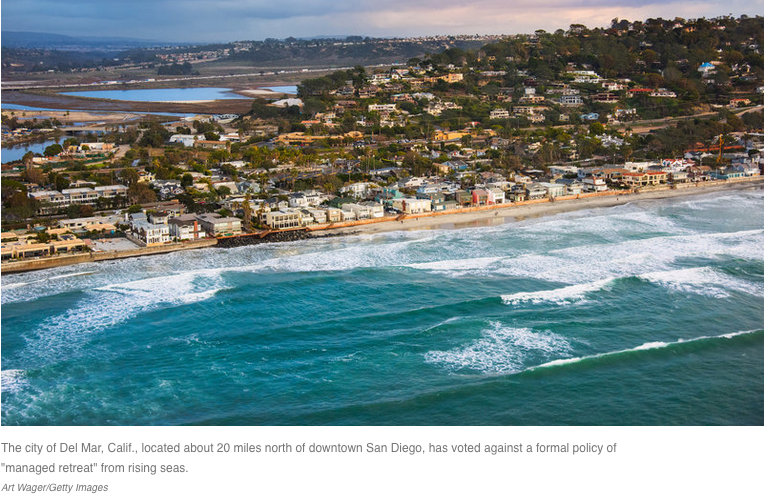
Related: 'Retreat' Is Not An Option As A California Beach Town Plans For Rising Seas: NPR

hurricanes, #searise, #bushfires, property values, insurance, #America, #Australia, #Houston, #wildfire,  

Friday, 4 September 2020

The Carbon Club/Book: 'You bastards sacked me.' (excerpt): SMH

climate change denial
The Carbon Club
How did environmental issues become so politicised? The people purge early in the Abbott government – beginning in 2013 with the "night of the short knives" – gives some clues.

By Marian Wilkinson

"What surprised the scientists most was not their hasty sacking but how quickly the government obliterated their work. “The website that we’d spent a lot of time building was taken down with absolutely no justification as far as I could see,” says Flannery, the one-time principal research scientist at the Australian Museum and internationally renowned scientific author. “It was giving basic information that was being used by many, many people – teachers and others – just to gain a better understanding of what climate science was actually about.”

climate change denial
Corruption
The Climate Commission had been set up in 2011 by Julia Gillard’s Labor government as an independent source of information for the public to understand climate change and its impacts on Australia. But the commission and its members had been pilloried as “alarmist” by sceptical columnists in the Murdoch media and by radio shock jocks from the beginning. Flannery was expecting the commission to be disbanded, but the decision to kill its website hurt."

..............................


climate change denial
We Want Climate Action Now

"Not long before this, the Liberal Party’s donor cash cow, the Cormack Foundation, which Morgan chaired, had stumped up another $300,000 for the Institute of Public Affairs. The conservative think tank’s latest publication, Climate Change: The Facts 2014, was soon in the works with essays from Australia’s best known climate sceptics, News Corp’s Andrew Bolt and former James Cook University professor Bob Carter, along with their international cohorts by now so familiar here: MIT’s Professor Richard Lindzen, Dr Pat Michaels from the US Cato Institute – a think tank co-founded by American billionaire Charles Koch – and the former UK chancellor Nigel Lawson.

climate change denial
Climate Justice
At the same time as Morgan’s attack, Lawson’s UK think tank, The Global Warming Policy Foundation, welcomed Abbott’s old mentor, John Howard, to deliver its annual lecture in London. The former Liberal prime minister used the opportunity to enthusiastically back Abbott’s plan to dismantle Labor’s climate policies in a speech he called “One Religion is Enough”."

..............................


"By the end of Abbott’s first year in office, the PM had made it clear he didn’t believe most climate scientists, even those who worked for his government. But while his climate scepticism could shape policy in Canberra, it would soon put him in conflict with the most powerful leader in the world, US president Barack Obama.

This is an edited extract from Marian Wilkinson’s The Carbon Club (Allen & Unwin, $33), out Monday."


Related:   MAJOR PARTIES LEAVE BACKDOOR OPEN FOR DIRTY DONATIONS


Abbott-Turnbull-Morrison Government, carbon emissions, corrupting donations, Institute of Public Affairs IPA, Koch brothers, Murdoch media, political party donations from corporations, Professor Flannery