Wednesday, 16 September 2020

Compromised: Genie Energy and the Murdoch media’s climate denial (excerpt): Michael West Media

(Pics by this blog)

See the interesting article below. 

The TV series 'The Rise of the Murdoch Dynasty' will soon be screened on ABC TV.

"Rupert Murdoch’s News Corporation has been integral to the propaganda war"
Murdoch series coming to ABC TV


"Rupert Murdoch, Dick Cheney, former CIA director James Woolsey, former US Treasury head Larry Summers, former US Energy Secretary Bill Richardson, hedge fund boss Michael Steinhardt and Jacob Rothschild have something in common. They are all on the board of oil and gas explorer, Genie Energy. Gas industry whistleblower Simone Marsh explores Rupert Murdoch’s fossil fuel interests.

Psychological warfare, or psywar, is the use of propaganda against an enemy, supported by such military, economic or political measures as may be required. Such propaganda is generally intended to demoralise the enemy, to break his will to fight or resist, and sometimes render him favourably disposed to one’s position. 
"News Corporation has been integral to the propaganda war"
Book: Hack Attack
Psychological warfare, winning the “hearts and minds” of the civil population, has been integral to the climate war.

And Rupert Murdoch’s News Corporation has been integral to the propaganda war; so much so that its Australian business has come under serious pressure this year amid anger over the coverage of the bushfires by major titles The Australian, the Herald Sun, Daily Telegraph, the Courier Mail and Foxtel’s Sky News.

Overnight, Rupert Murdoch’s son James publicly rebuked Murdoch’s Fox News over its climate denialism. Last week, a senior executive, Emily Townsend, took the extraordinary step of going public to criticise her own media organisation for its “dangerous” coverage of climate change. 

Behind the propaganda

"Rupert Murdoch’s News Corporation has been integral to the propaganda war"
Threats to democracy
The Murdoch press has always been avidly in favour of fossil fuels and notorious for spreading doubt about the science of global warming. It is worth looking, therefore, at the formal links between Rupert Murdoch and the oil and gas sector.

For a start, News Corp companies in Australia have extensive commercial arrangements with multinational oil and gas corporations. They take big advertising dollars, although how big remains a secret. Their newspapers stage “roundtables” or corporate conferences at which journalists and executives mingle with fossil fuel executives. Yet, rival media Nine Entertainment and its Australian Financial Review masthead does the same.

Where News is different is in Murdoch’s direct financial interest in oil and gas exploration in the Middle East, investments which also compromise New Corp’s coverage of Middle East politics and Israeli expansionism.

Murdoch has aligned himself with fossil fuel interests globally via the American Australian Association (AAA), and Genie Oil and Gas. Genie oil and gas is a division of Genie Energy and has been involved plans to frack in Israel. Its big project now, however, is exploring for oil in the Golan Heights, which is disputed territory once controlled by Syria."....................................."

Go to the complete Michael West Media article
by | Jan 15, 2020


Tuesday, 15 September 2020

Just 100 companies responsible for 71% of global emissions, study says (excerpt): The Guardian (3 years old but still relevant)

Pics from this blog

Note: A three year old article but what has changed apart from some greenwashing?

A relatively small number of fossil fuel producers and their investors could hold the key to tackling climate change

Just 100 companies have been the source of more than 70% of the world’s greenhouse gas emissions since 1988, according to a new report.

 
Exxon

The Carbon Majors Report (pdf) “pinpoints how a relatively small set of fossil fuel producers may hold the key to systemic change on carbon emissions,” says Pedro Faria, technical director at environmental non-profit CDP, which published the report in collaboration with the Climate Accountability Institute. 

Traditionally, large scale greenhouse gas emissions data is collected at a national level but this report focuses on fossil fuel producers. Compiled from a database of publicly available emissions figures, it is intended as the first in a series of publications to highlight the role companies and their investors could play in tackling climate change.

The report found that more than half of global industrial emissions since 1988 – the year the Intergovernmental Panel on Climate Change was established – can be traced to just 25 corporate and state-owned entities. The scale of historical emissions associated with these fossil fuel producers is large enough to have contributed significantly to climate change, according to the report.

Trump baselessly questions climate science during California wildfire briefing (excerpt): CNN

"(CNN) President Donald Trump on Monday baselessly asserted that climate change is not playing a role in the catastrophic wildfires overtaking forests across the west, rebutting an official briefing him who pleaded for the President listen to the science.

Trump at the briefing in California. Video at CNN article
 
"I don't think science knows, actually," Trump said at a Monday briefing with officials in McClellan Park, California, with a laugh.
 
 
He told Wade Crowfoot, secretary of California's Natural Resources Agency: "It'll start getting cooler. You just watch."
 
 
Crowfoot had warned the President of the dangers of ignoring the science and putting "our head in the sand and thinking that it's all about vegetation management." 
 
 
Climate experts tell CNN due to human-caused climate change, temperature extremes are climbing higher and the vegetation is drier, which affects fire behavior.
 
 
Trump was also directly confronted by the state's Democratic governor, Gavin Newsom, who has been adamant about climate change's role in the wildfires, bluntly telling the President: "Climate change is real." 
 
 
"We obviously feel very strongly the hots are getting hotter," Newsom said. 'The dries are getting drier. When we're having heat domes, the likes of which we've never seen in our history.'  "


Related: Australia in January, California in August': Aussies watch on in horror as wildfires ravage US west coast (excerpt): SBS

Monday, 14 September 2020

'Australia in January, California in August': Aussies watch on in horror as wildfires ravage US west coast (excerpt): SBS

Washington governor blames climate change for fires
Australia and Oregon


Former NSW fire chief Greg Mullins says the wildfires ravaging the US are a 'direct reflection' of what happened in Australia last summer, and serve as another 'wake up call' to pay attention to climate change.

With up to 100 wildfires burning across multiple states on the US west coast, the situation is is eerily reminiscent of Australia’s deadly bushfire event of 2019-20.

Ross Bradstock is from the Centre for Environmental Risk Management of Bushfires at the University of Wollongong. He says what Australia went through last summer "is repeating itself in places like California". 

“We’re seeing something similar play out over there as to what played out in our last season in terms of unprecedented fires, unprecedented area burnt, unprecedented drought and heat,” he told SBS News.


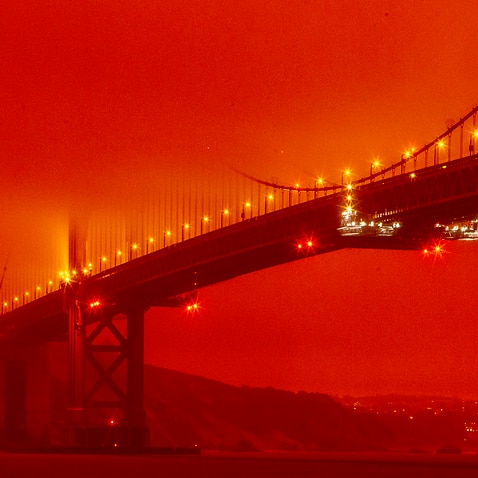
In this photo provided by Frederic Larson, the Golden Gate Bridge is seen at 11 a.m. PT amid a smoky, orange hue caused by the ongoing wildfires, Wednesday, Sept. 9, 2020, in San Francisco. (Frederic Larson via AP)
San Francisco, Pic from SBS story


Former NSW Fire and Rescue Commissioner Greg Mullins has helped to fight fires in California several times since the 1990s. 

He agrees the current wildfires are "a direct reflection" of what Australia faced.

"It's unprecedented," Mr Mullins told SBS News.

"The temperatures they're getting - you know, 49.4 (degrees) in the eastern suburbs of Los Angeles - nothing has ever come close." .................


Go to complete article By Rashida Yosufzai, Jodie Stephens

Related: Washington governor blames climate change for fires (excerpt): abc news


Washington governor blames climate change for fires
 Fires near Sydney, Pic from this blog

Sunday, 13 September 2020

Scientists say they're being silenced by the government: from ABC Radio

"On RN Breakfast with Fran Kelly
scientists employed by government and industry had work "unduly modified
science or fiction


As the Morrison Government rushes to amend national environmental protection laws, scientists warn a growing number of their colleagues are being silenced.

A study by the Ecological Society of Australia claims a third of ecologists and conservation scientists employed by government and industry had work "unduly modified" and almost half of those working for government were blocked from releasing their findings.

Their treatment has renewed calls for the creation of an independent environmental agency, something the Coalition has ruled out.

scientists employed by government and industry had work "unduly modified
The scientific conspiracy!
Featured:
Don Driscoll, Professor in Terrestrial Ecology, Deakin University

Producer: Cathy Van Extel

Duration: 8min 57sec

Saturday, 12 September 2020

Washington governor blames climate change for fires (excerpt): abc news

Washington Gov_ Jay Inslee says the fires devastating California and the Northwest shouldn’t be called wildfires, but “climate fires.”


The Climate Disasters We Ignore Today Will Eventually Come for Us (excerpt): Gizmodo


Even if the world does act, some climate disasters may be inevitable
Vehicles ply on waterlogged Delhi-Gurgaon Expressway
 near Narsingpur after heavy rains, in Gurugram
..... "In a just world, this would be major news, even in the faraway U.S. Perhaps stories about the local covid-19 crises we’re seeing across the country would get more attention, but surely, the displacement of millions deserves a spot on the front page. And yet.


If you didn’t know these floods were happening, I’m not here to scold you. Tragedies take place around the world every day, from bombings to hunger. Plus, here in the U.S., things are pretty awful for lots of people, too. It’s difficult if not impossible to keep up with every bad thing happening in all places. It’s also, frankly, easier for many of us in the Global North to ignore crises that are happening to poor people far away. When these crises do surface in news reports, many of us are taught to treat them as inevitable — things are simply more difficult for people “over there.”


This can all lead us to feel insulated from these horrors. We need to
Even if the world does act, some climate disasters may be inevitable
Local residents look at a submerged bus in a waterlogged road 
underpass after monsoon rainfalls in New Delhi
 (Photo: Prakash Singh, Getty Images)
fight that impulse. Caring about our fellow human beings is the right thing to do, sure. But even if empathy isn’t your thing, there’s also an uncomfortable reality: Climate disasters will eventually come for us all if we don’t act now. 


The deafening silence about climate change-fuelled weather in the Global South isn’t limited to the recent floods in South Asia. People have died in deluges in India and Bangladesh in previous years, too — hundreds last year, 1,000 in 2018, over 1,200 in 2017. Hurricane Dorian, one of the most intense hurricanes to ever form in the Atlantic Ocean, absolutely ravaged the Bahamas just last year. Yet it has all but faded from popular memory in the U.S. aside from the saga of Sharpiegate. And nearly three years after Hurricane Maria hit Puerto Rico, thousands are still without homes and the power grid recently crashed again in the face of a moderate tropical storm yet these stories of widespread suffering are rarely found on front pages. 


Even if the world does act, some climate disasters may be inevitable
World leaders plan for climate change
All of this devastation was not inevitable. World leaders could have taken steps to move us away from fossil fuels decades ago. They also could have poured far more resources into helping vulnerable people adapt before emergencies strike, and rebuild after they do. But they’ve made clear they won’t do much of that of their own accord — they claim it’s too expensive, too difficult, too impractical. We need a mass movement that shows them we won’t take no for an answer, and part of that is recognising the toll the crisis is already taking and acting with urgency and compassion.
World leaders already have blood on their hands. Every life these actions could have saved is important. Each of the hundreds of Indian and Bangladeshi people killed by the ongoing monsoons in India deserved better. And we all deserve better than to see this continue.


That’s not just because it’s the right thing to do. It’s also our only option. Eventually, ecological horror will come for all of us. It might be in a month, a year, or 20 years, but eventually, a storm, heat wave, or tornado will come banging down your door. The time to change course is now, starting with, at a minimum, acknowledging the impacts the climate crisis on the poorest among us. 


Even if the world does act, some climate disasters may be inevitable
We want climate action now
Even if the world does act, some climate disasters may be inevitable since we’ve already overheated the planet and left people vulnerable. We won’t be able to stop every flood or heat wave from taking place. But what’s not inevitable is our treatment of some people as disposable. If we prioritise taking steps to help people adapt and prepare, countless lives could be saved. Stopping deforestation of catchment areas and restoring wetlands, for instance, could go a long way to better shielding communities in India and Bangladesh from rising waters. So could national policies to provide more resilient housing to all people, and international policies to prioritise aid to the struggling countries that are hit hardest......"

Go to complete Gizmodo story by Dharna Noor, August 21, 2020

Related:  Climate Change Poses Serious Threats to India's Food Security (excerpt): The Wire