"As
Australia scrambles to avoid its first recession in three decades,
economist Ross Garnaut says it is "exactly the right time" for
government to throw cash into renewable energy infrastructure.
The
global outbreak of COVID-19 has already taken a bite out of tourism,
education and export industries, with the federal government working on a
stimulus package to stave off a recession.
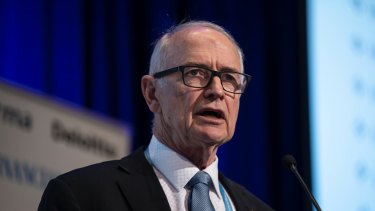
Professor Ross Garnaut says government should be investing in renewable energy. Credit:Louie Douvis
Professor
Garnaut said the country could not avoid sliding into a recession, but
governments could "shape the way we come out of it".
"Even if
there was no disruption in Australia from the virus, what has already
happened to the economies of our major trading partners is deeply
damaging to the Australian economy," he said, speaking at a CEDA lunch
in Brisbane on Wednesday.
"The
pure economics say right now is exactly the right time for major
investment in the industries and infrastructure of the future."
"The high cost of transporting renewable energy overseas made
Australia the perfect candidate to process its own iron, aluminium and
other raw minerals, he said.
"Play it right and Australia has
exceptional opportunities for new areas of prosperity and economic
expansion in the zero-emissions world economy," he said."
My message today is simple. Climate
change poses significant risks to the economy and to the financial
system, and while these risks may seem abstract and far away, they are
in fact very real, fast approaching, and in need of action today.
That’s how Sarah Breeden began her speech titled “Avoiding the storm: Climate change and the financial system”
(pdf) yesterday. Breeden is the Bank of England’s executive director of
International Banks Supervision and she was speaking at the Official
Monetary & Financial Institutions Forum in London.
The urgency in Breeden’s speech was also on display on London’s streets. Earlier in the day, the environmental group Extinction Rebellion blocked traffic
in five iconic locations across the city in a peaceful, non-violent
protest to bring attention to “inactivity” of governments on fighting
climate change.
• Suddenly, many conservative politicians in Australia have 'backflipped' and now publicly accept that we are living in an age of rapid climate change....
BUT
Vote for my future climate
• Many politicians still fail to grasp the catastrophic impacts of climate change all life on Earth will soon experience, therefore they are only 'greenwashing' their election campaigns.
• Most scientists believe we are very likely to heat the planet well beyond 2 degrees. • The Liberal - National Party Coalition has loudly and publicly rebadged Tony Abbott's Direct Action funding, which inefficiently used your taxes to bribe polluters but has the proposed funding allocation by $200 million at the same time.
• Under the threat of an election defeat by a
The young want climate action
climate activist, Tony Abbott now says he believes in climate change. • NSW has the biggest state economy yet it's contribution to planning for climate change and slowing global heating is pitiful. • Yet some National Party and Liberal Party MPs still want to build new, subsidised, coal-powered energy generators even though renewable energy is cheaper and as reliable. • The Federal Labor Party still supports the Queensland Labor Party's support of new, massive, coal mines. It has no plan to transition coal workers out of coal mining jobs. • The above parties have no real planning for slowing and mitigating the effects of climate change. It is unlikely we will meet the Paris targets, (don't believe the false accounting of the the Liberal Party - National Party Coalition).
• Only candidates promising a massive attack on the causes of climate change and promising real planning for more economic downturns, droughts, heat waves, bush fires, epidemics, food and water shortages, health epidemics, ocean acidification, animal extinctions, sea inundations, property devaluations and waves of climate refugee immigration deserve your first vote.
"New data proves you can support capitalism or the environment — but it’s hard to do both."
"But ending growth doesn’t mean that living standards need to take a hit.
Our planet provides more than enough for all of us; the problem is that
its resources are not equally distributed. We can improve people’s
lives right now simply by sharing what we already have more fairly,
rather than plundering the Earth for more. Maybe this means better
public services. Maybe it means basic income. Maybe it means a shorter
working week that allows us to scale down production while still
delivering full employment. Policies such as these — and countless
others — will be crucial to not only surviving the 21st century but also
flourishing in it."
"Stephen Schneider explores what a world with 1,000 parts per million of CO 2 in its atmosphere might look like."
.... "Fairness must also be taken into account, given that some people would be at much greater risk than others: poor people in hot countries with little adaptive capacity, for instance, indigenous peoples and those exposed to hurricanes or wildfires, or living in low-lying areas. The elderly and children with asthma or other lung ailments would be particularly affected by urban air pollution or wildfire smoke plumes exacerbated by the extreme warming.
The economic outlook is no better. With warming of just 1–3 °C, projections show a mixture of benefit and loss. More than a few degrees of warming, however, and aggregate monetary impacts become negative virtually everywhere; and in a 1,000 p.p.m. scenario current literature suggests the outcomes would be almost universally negative and could amount to a substantial loss of gross domestic product. Millions of people at risk from flooding and
water supply problems would provide further economic challenges." ...
"As we head into another cycle of climate change politics beware the economic doomsayers"
"Thirdly, because Australia exports a lot of coal and other
emissions-intensive products to other countries, what they do matters an
awful lot to the Australian economy. As other nations reduce emissions,
demand for these products falls regardless of what we do. It has been
established for some time that a significant part of the economic
impacts of climate change on Australia comes from things we can’t
control and this is generally presented in the results (see here
for an example). While he does not report this, Brian Fisher knows this
because he spearheaded economic analysis in the 1990s that was targeted
at convincing Japan, one of our major coal markets, it would be too
costly for them to reduce emissions." .......
"Lastly, whenever these headlines are blasted across the papers one point
is always lost: these results don’t include the cost of climate change
itself. This summer, we have again seen a glimmer of what climate change
will mean for Australia. Recent economic analysis indicates the
benefits of limiting global warming far outweigh the cost of doing so,
in one case by 70-1 (a good summary is here).
(Again, this is something Fisher has considered in the past as he once
said it would be cheaper to move people from the Pacific and put them in
condos on the Gold Coast than act on climate change.)" ......
It found that in that scenario, the assets were effectively
overvalued today by $2.5tn, but that there was a 1% chance that the
overvaluation could be as high as $24tn. The losses would be caused by the direct destruction of assets by
increasingly extreme weather events and also by a reduction in earnings
for those affected by high temperatures, drought and other climate
change impacts."