Friday, 12 July 2019

How to erase 100 years of carbon emissions? Plant trees—lots of them.
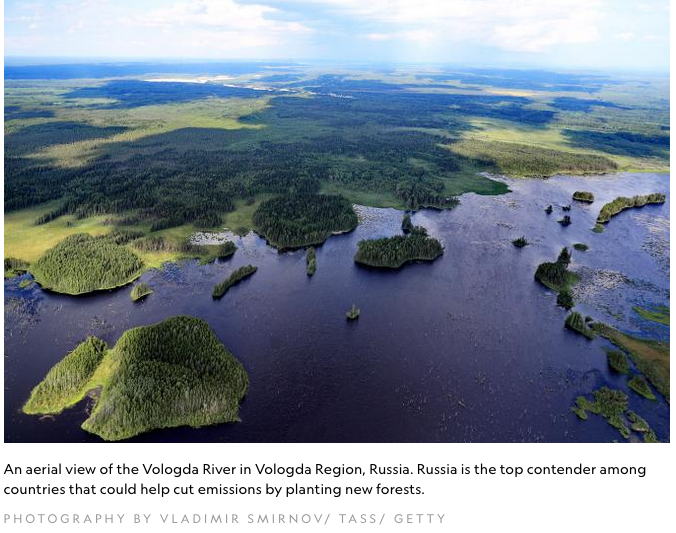
Increasing the Earth’s forests by an area the size of the United States would cut atmospheric carbon dioxide 25 percent.
PUBLISHED
An area the size of the United States could be restored as forests
with the potential of erasing nearly 100 years of carbon emissions,
according to the first ever study to determine how many trees the Earth could support.
Published today in Science, "The global tree restoration potential”
report found that there is enough suitable land to increase the world’s
forest cover by one-third without affecting existing cities or
agriculture. However, the amount of suitable land area diminishes as
global temperatures rise. Even if global warming is limited to 1.5
degrees Celsius, the area available for forest restoration could be
reduced by a fifth by 2050 because it would be too warm for some
tropical forests.
“Our study shows clearly that forest restoration is the best climate
change solution available today,” said Tom Crowther, a researcher at ETH Zürich, and senior author of the study.
That does not alter the vital importance of protecting existing forests and phasing out fossil fuels since new forests would take decades to mature, Crowther said in a statement.
Read the complete National Geographic article
Read also:
Related: 6 Glimmers of Climate Optimism for the End of a Dark Year: Medium
Read the complete National Geographic article
Read also:
Exaggerating how much carbon dioxide can be absorbed by tree planting risks deterring crucial climate action
Related: 6 Glimmers of Climate Optimism for the End of a Dark Year: Medium
Thursday, 11 July 2019
6 Glimmers of Climate Optimism for the End of a Dark Year: Medium
It was a year of frightening reports on the future of our planet. But sustainability experts are still feeling optimistic about some of the strides we’ve made this year.

The consensus among scientists, researchers, and sustainability experts following this years’ reports is that while stopping climate change will require an undoubtedly Herculean effort, the biggest hurdle is political, not technical. In other words, if all the innovations in sustainable technology and science were harnessed and directed at reducing emissions and environmental collapse, we might stand a chance at meeting the goals laid out in the reports.
Don’t
get us wrong: It will take a heroic, global effort if we’re even going
to come close to limiting global warming to 1.5 degrees Celsius–the
point after which, according to the reports, large swaths of the planet
will become uninhabitable, and issues like mass starvation will become
widespread. And the lack of leadership from the United States, under
climate change denier Donald Trump, is making cohesive political action
difficult.
But
underneath all this, activists, scientists, and business leaders are

Related:
Restoring forests may be one of our most powerful weapons in fighting climate change: Vox
Wednesday, 10 July 2019
Fossil fuel exports make Australia one of the worst contributors to climate crisis : The Guardian

Under climate accounting rules that record carbon dioxide released within a country, Australia is responsible for about 1.4% of global emissions. The analysis by science and policy institute Climate Analytics found more than twice that, another 3.6%, are a result of Australia’s coal, oil and gas exports.
Restoring forests may be one of our most powerful weapons in fighting climate change: Vox
 |
| Preserve Forests |
Adding 2.2 billion acres of tree cover would capture two-thirds of man-made carbon emissions, a new study found.
Allowing the earth’s forests to recover could soak up a
significant amount of humanity’s greenhouse gas emissions, according to
new research.
The worldwide assessment of current and potential forestation using satellite imagery appeared Thursday in the journal Science.
It estimates that letting saplings regrow on land where forests have
been cleared would increase global forested area by one-third and remove
205 billion metric tons of carbon from the atmosphere. That’s
two-thirds of the roughly 300 billion metric tons of carbon humans have
put up there since the dawn of the Industrial Revolution.
“The point is that [reforestation is] so much more vastly
powerful than anyone ever expected,” said Thomas Crowther, a professor
of environmental systems science at ETH Zurich and a co-author of the
paper. “By far, it’s the top climate change solution in terms of carbon
storage potential.”
Some climate scientists who were not involved with the study disagree
with its calculations and are warning against its “silver bullet”
message. Still, supporting natural systems that can soak up carbon is
widely accepted as a major component of any climate change mitigation
strategy — in addition to deploying clean energy, switching to electric
vehicles, and curbing consumption overall.
See also:
Three Surprising Solutions To Climate Change: Forbes
Monday, 8 July 2019
Climate change: what to expect and are there really two sides? | Ask Bob: Video
Published on Nov 4, 2017
Many view climate change as the most pressing issue of our time. But how, specifically, is it going to affect us and our planet? Is there still time to make a difference? And what does it mean to believe "both sides" of climate change science? CBC's Bob McDonald weighs-in.
Related:
How high will sea levels rise- ABC Science
Sunday, 7 July 2019
How high will sea levels rise- ABC Science
This video was made in 2014. We now have evidence the Greenland ice shelf and Antarctic ice shelf is melting more quickly than first thought.
ABC Science
Published on Jul 18, 2014
ABC Science
Published on Jul 18, 2014
The rising sea is the sleeping giant of climate change. Although we now know it's happening, how high will it go? In an attempt to predict what impact the rising waters will have on our world, scientists are turning to the distant past.
Subscribe to:
Posts (Atom)