"As
Australia scrambles to avoid its first recession in three decades,
economist Ross Garnaut says it is "exactly the right time" for
government to throw cash into renewable energy infrastructure.
The
global outbreak of COVID-19 has already taken a bite out of tourism,
education and export industries, with the federal government working on a
stimulus package to stave off a recession.
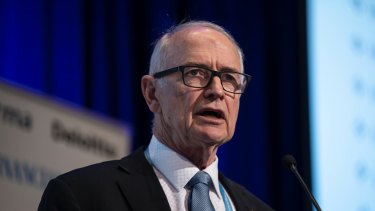
Professor Ross Garnaut says government should be investing in renewable energy. Credit:Louie Douvis
Professor
Garnaut said the country could not avoid sliding into a recession, but
governments could "shape the way we come out of it".
"Even if
there was no disruption in Australia from the virus, what has already
happened to the economies of our major trading partners is deeply
damaging to the Australian economy," he said, speaking at a CEDA lunch
in Brisbane on Wednesday.
"The
pure economics say right now is exactly the right time for major
investment in the industries and infrastructure of the future."
"The high cost of transporting renewable energy overseas made
Australia the perfect candidate to process its own iron, aluminium and
other raw minerals, he said.
"Play it right and Australia has
exceptional opportunities for new areas of prosperity and economic
expansion in the zero-emissions world economy," he said."
The Greens NSW successfully amended the COVID-19 Emergency Measures Bill
in NSW Parliament last night, to enable protections for renters to be
part of the emergency response by the relevant Ministers now that
Parliament has been adjourned.
Greens NSW MP and Housing spokesperson, Jenny Leong MP, said today:
“The COVID-19 Bills introduced by the NSW Government yesterday didn't
include any measures for renters or tenants - in fact there was nothing
that even began to address the housing and homelessness crisis that is
just around the corner if we don't act swiftly.”
“This isn’t just a human rights issue: it’s a health issue. You can’t
stay home to social distance without a house. You can’t limit your
shopping without a fridge. You can’t rest and recover without a bed.
“Yesterday morning, after getting the Bill late Monday night, I started
working with the NSW Tenants Union to draft amendments that would
address this massive oversight, these amendments were introduced by the
Greens and subsequently passed into law.
“The amendments give the power to the relevant ministers in NSW to
create regulations to put a moratorium on evictions, prevent people
having their lease terminated and make other changes to what current
powers landlords and owners have over tenants.
“If this amendment hadn't been made, they would have had to draft
legislation, wait until parliament resumed (next scheduled date in
September), then have the legislation debated & passed.
“While these amendments give delegated power to the relevant minister to
act, they still need to do that. The National Cabinet including the NSW
Premier is meeting tonight, and tenancy is on the agenda. They can and
should decide tonight to provide security and relief for renters that
can be implemented immediately.
“These are extraordinary times, and these are extraordinary powers,
powers that can be used for good - right now - to protect residential
and commercial tenants from evictions.
“By passing these NSW Greens amendments to protect renters, the
Parliament has put the ball in the Liberals court: they have the
capacity to stop families being kicked out of their homes in the middle
of this crisis,” Ms Leong said.
"It
is a global emergency that has already killed on a mass scale and
threatens to send millions more to early graves. As its effects spread,
it could destabilise entire economies and overwhelm poorer countries
lacking resources and infrastructure. But this is the climate crisis,
not the coronavirus. Governments are not assembling emergency national
plans and you’re not getting push notifications transmitted to your
phone breathlessly alerting you to dramatic twists and developments from
South Korea to Italy.
More than 3,000 people
have succumbed to coronavirus yet, according to the World Health
Organization, air pollution alone – just one aspect of our central
planetary crisis – kills seven million people
every year. There have been no Cobra meetings for the climate crisis,
no sombre prime ministerial statements detailing the emergency action
being taken to reassure the public. In time, we’ll overcome any
coronavirus pandemic. With the climate crisis, we are already out of
time, and are now left mitigating the inevitably disastrous consequences
hurtling towards us."
.....................................
"Imagine, then, that we felt the same sense of emergency about the
climate crisis as we do about coronavirus. What action would we take? As
the New Economic Foundation’s Alfie Stirling points out, a strict
demarcation between the two crises in unwise. After all, coronavirus may
trigger a global slowdown: the economic measures in response to this
should be linked to solving the climate crisis. “What tends to happen in
a recession is policy-makers panic about what the low-lying fruits are;
it’s all supply chains and sticking plasters,” he tells me. During the
2008 crash, for example, there was an immediate cut in VAT and interest
rates, but investment spending wasn’t hiked fast enough, and was then
slashed in the name of austerity. According to NEF research, if the
coalition government had funded additional zero-carbon infrastructure,
it would not only have boosted the economy but could have reduced
residential emissions by 30%. This time round, there’s little room to
cut already low interest rates or boost quantitative easing; green
fiscal policy must be the priority."
"Coronavirus poses many challenges and threats, but few opportunities. A
judicious response to global heating would provide affordable transport,
well-insulated homes, skilled green jobs and clean air. Urgent action
to prevent a pandemic is of course necessary and pressing. But the
climate crisis represents a far graver and deadlier existential threat,
and yet the same sense of urgency is absent. Coronavirus shows it can be
done – but it needs determination and willpower, which, when it comes
to the future of our planet, are desperately lacking."
Professor John Dabiri and his team have been conducting research for over 8 years on the potential of small vertical-axis wind turbines
(VAWTs) for wind farms. According to their data, by using the wind
wakes that so drastically inflate the size of wind farms using
horizontal-axis wind turbines (HAWTs) constructively, rather than
destructively, a VAWT farm could produce the same amount of power in
1/10th the land area, using turbines that are around 1/8th as tall. This
has huge potential for industrial power production, as Dabiri et al
rightfully point out, but I see an equal potential in a smaller niche:
energy independence.
Photovoltaic solar panels (PVs) are currently the standard for
community energy independence, from experimental ecovillages, to
exploited areas such as Puerto Rico or Navajo Nation, to more privileged people
looking to reduce their reliance on fossil fuels. This makes sense -
even using the synergistic VAWT layout, solar still outperforms wind in
power-per-area, assuming roughly equal reliability of wind and sun. PVs
have a host of other problems,
though, most notably a very high energy input, high cost, reliance on
industrial production, and lots of intermittency from nighttime, clouds,
and winter requiring large batteries. On the other hand, VAWTs can be
built by the communities hoping to use them, potentially at very low cost
in both energy and money, and run much more consistently through the
night and the winter - potentially making up for the extra land area
While the synergistic VAWT layout is very efficient in terms of power-per-area, the one concern I have is power-per-turbine.
A dynamo on each windmill could inflate the cost of the system quickly,
and though smaller generators can be built from salvaged electric
motors, the ideal turbine for this system is too large for any consumer
washing machine or dryer motor and so finding enough motors could be
tough. I believe the best solution to this would be mechanical
transmission to a central generator, either through something like a jerker line
or - my preferred idea - water pressure. Each turbine could run a
mechanical pump, sending water through a series of pipes to run a
single, large water wheel - which could either be salvaged from old
industrial machinery or built by the community. This system could be
incorporated into plumbing, welling, purification/desalination, etc. and
could even be attached to a gravity battery system, pumping water
upward when supply exceeds demand to be run back through the turbine
when demand exceeds supply and thus solving the intermittency problem. A
system like this would also be really easy to expand as needed
Of
course, this kind of design isn’t a catch-all solution - nothing is.
Areas with more reliable sunlight (such as tropical regions or deserts)
and/or less reliable wind might benefit more from solar power, whereas
communities with small enough energy demands to be provided by a single
HAWT (like Open-Source Ecology’s design,
for instance) wouldn’t have to deal with wakes at all, and thus could
provide their power with only the space needed for its physical
structure and access to the wind. I definitely think there are cases
where synergistic VAWT clusters would be a great fit, though, and I hope
this post inspires engineers, makers, and communities to start working
on a robust, open-source design for such a system
On January 30, 2020, the World Health Organization (WHO) declared that the outbreak of novel coronavirus 2019, which causes the disease COVID-19, was
officially a “public health emergency of international concern.” At the
time, there were cases confirmed in 19 countries and deaths in China
had reached 170.
“Is coronavirus worse than the flu?” it began. “No, not even close.” “It already has spread from person-to-person in the U.S., but it probably won't go far,” ACSH added. “And the American healthcare system is excellent at dealing with this sort of problem.”
ACSH is one of several organizations
promoting climate science denial that are now spreading misinformation
on the coronavirus, with potentially deadly consequences.
American Council on Science and Health?
The ACSH presents itself to the public as a
proponent of “peer-reviewed mainstream science,” in the words of the
organization’s mission. Their experts have frequently been quoted in
mainstream newspapers and magazines, and they pen columns criticizing
journalists who write critically about companies like Monsanto. The group has received funding from oil giants including ExxonMobil, as well as from the agribusiness, chemical and tobacco industries to name a few.
To mark the end of The Frontline series a panel of experts answer your questions about the climate crisis and how it is affecting Australia.
Ask Prof Lesley Hughes, Greg Mullins, Prof Michael Mann and Assoc
Prof Donna Green your questions, and see the answers on our live blog.
Email frontline.live@theguardian.com or tweet #frontlinelive
Thanks to my colleagues Marni Cordell and Adam Morton for their help running the blog today, and everybody else who put The frontline together.
It’s a beautiful, affecting multimedia series that looks at real
people and the impacts the climate emergency is already having.
Thanks so much for reading, following and asking questions of our
experts. It was a great and informative discussion, to mark a stellar
project, and I hope to see you all again soon.
Logging is continuing in NSW forest north-west of Coffs Harbour in bushland that is proposed for the Great Koala national park.
Photograph: International Fund For Animal Welfare
The New South Wales
Forestry Corporation has continued to log unburnt forest that is
habitat for some of the most imperilled species in the aftermath of the
state’s bushfire crisis.
Logging operations have continued in the Styx River state forest on
the north coast that is now remnant habitat for endangered species
including the greater glider and the Hastings River mouse.
Both the federal and state
governments have identified the mouse, which had 82% of its habitat
burnt, as one of the species most at risk of extinction as a result of
the bushfire disaster.
Trucks have also moved into an area of the Lower Bucca state forest
north-west of Coffs Harbour in bushland that is part of the proposed
Great Koala national park.
Twenty-four per cent of koala habitat in eastern NSW was burnt in the
fire crisis and the environment minister, Sussan Ley, has said up to 30% of the koala population on the mid north coast may have been killed.
Environment groups and the independent state MLC Justin Field have
expressed dismay that NSW Forestry Corporation has been able to continue
with harvest plans in unburnt forest that is now important remnant
habitat for wildlife.