Oil
and gas companies are hurtling toward bankruptcy, raising fears that
wells will be left leaking planet-warming pollutants, with cleanup costs
left to taxpayers.
An
infrared image last year of an MDC Energy well pad leaking methane
(which is invisible to the naked eye). This month, the site has
continued to leak gases, government violations show. Credit...Jonah M. Kessel/The New York Times
The
day the debt-ridden Texas oil producer MDC Energy filed for bankruptcy
eight months ago, a tank at one of its wells was furiously leaking
methane, a potent greenhouse gas, into the atmosphere. As of last week, dangerous, invisible gases were still spewing into the air.
What was the climate and sea level like at times in
Earth’s history when carbon dioxide in the atmosphere was at 400ppm?
The last time global carbon dioxide levels were consistently at or above 400 parts per million (ppm) was around four million years ago during a geological period known as the Pliocene Era (between 5.3 million and 2.6 million years ago). The world was about 3℃ warmer and sea levels were higher than today.
We
know how much carbon dioxide the atmosphere contained in the past by
studying ice cores from Greenland and Antarctica. As compacted snow
gradually changes to ice, it traps air in bubbles that contain samples of the atmosphere at the time.
We can sample ice cores to reconstruct past concentrations of carbon
dioxide, but this record only takes us back about a million years.
Beyond
a million years, we don't have any direct measurements of the
composition of ancient atmospheres, but we can use several methods to
estimate past levels of carbon dioxide. One method uses the relationship
between plant pores, known as stomata, that regulate gas exchange in
and out of the plant. The density of these stomata is related to atmospheric carbon dioxide, and fossil plants are a good indicator of concentrations in the past.
Another
technique is to examine sediment cores from the ocean floor. The
sediments build up year after year as the bodies and shells of dead
plankton and other organisms rain down on the seafloor. We can use
isotopes (chemically identical atoms that differ only in atomic weight)
of boron taken from the shells of the dead plankton to reconstruct
changes in the acidity of seawater. From this we can work out the level
of carbon dioxide in the ocean. The data from four-million-year-old sediments suggest that carbon dioxide was at 400ppm back then.
Sea Levels and Changes in Antarctica
During colder periods in Earth's history, ice caps and
glaciers grow and sea levels drop. In the recent geological past, during
the most recent ice age about 20,000 years ago, sea levels were at
least 120 meters lower than they are today.
Sea-level changes are calculated from changes in isotopes of oxygen in the shells of marine organisms. For the Pliocene Era, research
shows the sea-level change between cooler and warmer periods was around
30-40 meters and sea level was higher than today. Also during the
Pliocene, we know the West Antarctic Ice Sheet was significantly smaller
and global average temperatures were about 3℃ warmer than today. Summer
temperatures in high northern latitudes were up to 14℃ warmer.
This may seem like a lot but modern observations show strong polar amplification
of warming: a 1℃ increase at the equator may raise temperatures at the
poles by 6-7℃. It is one of the reasons why Arctic sea ice is
disappearing.
• We are looking more and more unlikely to prevent global heating. • Scientists are predicting the melting of the ice covering Greenland with a subsequent sea level rise of 7m. • This rise does not factor in sea rise from the melting of Antarctica and other ice.
• Already many properties are likely to flood when a high tide is
combined with high local rainfall. What were 'hundred year' rainfall events are
now 'ten year' events.
• Victorian state planning policy seems to underestimate likely sea level rise and doesn't seem to look beyond 2100, however, infrastructure will be expected to survive well beyond 2100.
"Consistent with state planning policy to ‘plan for possible sea level rise of 0.8 metres by 2100, and allow for the combined effects of tides, storm surges, coastal processes ...’, these guidelines apply to areas that will be affected by tidal inundation within the Port Phillip and Westernport region." Melbourne Water Planning for Sea Level Rise 2017
• The frequency of high
rainfall events will increase with global heating and more and more
severe hurricanes are predicted because of warmer seas. • Low coastal areas will be subjected to severe storm surges. •
Would you buy a property likely to be inundated in twenty years, fifty
years, a hundred years? Many wouldn't. Even the perception of possible
inundation will greatly affect property values. • When certain properties are in less demand their value falls. It becomes more and more difficult to ensure properties at risk of tidal surges and flooding. • Would you buy a property with a value likely to fall? • The view of Melbourne above shows areas likely to be inundated by a 7m sea level rise. • Property above a 10m rise will become highly sought after and will greatly rise in value. Learn more about how sea rise inundation will affect Australian property. Click here to go to Coastal Risk Australia site
Climate litigation is not going away any time soon.
Lawsuits demanding accountability and action on the existential
threat of climate change continue to take hold across the world with
some significant new developments and new cases emerging over the past
year, according to a new report on trends in global climate change litigation.
That report,
published July 3 by the London School of Economics’ Grantham Research
Institute on Climate Change and the Environment, provides an overview of
climate change lawsuits around the world including key developments
between May 2019 and May 2020. Grantham Research Institute maintains a database of global climate change lawsuits and in recent years has issued annual reports on trends in climate litigation.
Over the past three decades climate change lawsuits have spread
across six continents with over 1,500 cases identified in 37 countries,
according to the latest report. Most of these cases are in the U.S.,
though increasingly cases are emerging outside the U.S.
including 26 new cases in the last year alone. The Global South (Asia,
Africa and Latin America) has seen 37 cases of climate litigation
to date.
While a majority of climate-related lawsuits are routine cases such
as regulatory proceedings or challenges to fossil fuel permitting, cases
are also being brought more strategically as a way to hold governments
and companies accountable for damaging climate impacts. This kind of
litigation against national governments and against fossil fuel
companies has taken off in recent years.
New study out today on climate litigation across the world – shows humans rights are increasingly being used to support cases & that plaintiffs are using new strategies to bring lawsuits against major fossil fuel companies https://t.co/1tD7dVKlJ6pic.twitter.com/7FO7DK4DiC
Record permafrost temperatures are transforming the Arctic, especially
for indigenous peoples, whose hunting livelihoods are at risk as ground
melts
Frozen
ground in the Arctic is thawing, harming indigenous people’s hunting
livelihoods and destabilising buildings and roads across the rapidly
warming region.
Air temperatures hit 38C in Russia on 20 June in the Russian town of
Verkhoyansk in Siberia, claimed as a heat record in the Arctic, which is
warming twice as fast as the global average.
The previous day, the land surface temperature hit an extraordinary 45C at several locations in the Arctic Circle, according to European satellite data.
Often overlooked compared to air temperature records, temperatures in
the ground are trending ever higher across the Arctic, according to the
UN panel of climate scientists.
Permafrost, permanently frozen ground often just below the surface
which melts to mud in summer, covers about a quarter of the land in the
northern hemisphere. And shrinking permafrost is causing wrenching
long-term changes to nature.
“As one of our elders says: ‘Nature doesn’t trust us any more’,” said
Vyacheslav Shadrin, chair of the Yukaghir Council of Elders, of the
Republic of Sakha-Yakutia in the Russian far east, about 600 km from
Verkhoyansk. The Yukaghir total about 1,500 people.
“We can’t predict what will happen tomorrow. This is maybe the main
challenge. All our lives are based on traditional knowledge. We used to
know that tomorrow we catch fish or have our reindeer. Now we can’t
say,” he told Climate Home News. Rivers that were reliable roads for
months in winter can now be treacherous.
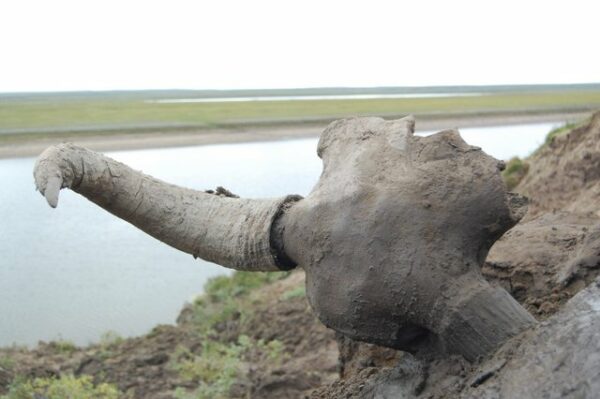
A bison horn revealed by melting permafrost in Siberia (Pic: Johanna Anjar)
Until a few decades ago, he said that many Yukaghir did not dig up
ancient mammoth bones or tusks, fearing that disturbing bones entombed
in the frozen soil could release malevolent spirits from an underworld
below.
Today, however, the thaw of permafrost means such finds are more
common – and valuable to collectors – and many Yukaghir have abandoned
the belief.
“Traditionally the most forbidden things are connected to the
mammoth, the spirit of the underworld. Now we use mammoth bones as a
profit,” he said.
Around the Arctic, the loss of white snow and ice that reflects
sunlight back to space reveals darker soil and water, that absorb ever
more heat and accelerates the thaw.
At the time of publication, the extent of sea ice in the Arctic Ocean
was tracking close to 2012 levels, the minimum on records dating back
to 1979, NSIDC data show. On land, snow and ice cover is also among the
lowest for the time of year, according to Rutgers University, and Greenland’s melt so far this year is also rapid, adding to sea level rise.
The World Meteorological Organization said it is checking last
month’s heat record in Siberia. Daily records can be natural freaks –
Fort Yukon on the Arctic circle in Alaska hit 37.7C as long ago as 1915,
before climate change was a worry.
The temperature spike in Siberia was “an iconic threshold that
indicates the warming we’re seeing over the long term” both in the air
and the soil, said Walt Meier, senior research scientist at the US
National Snow and Ice Data Center.
“The Arctic is warming about twice as fast as the rest of the globe
and the Siberian region, even in the Arctic, is warming rapidly,” he
told CHN. “We’re seeing buildings cracking, roads buckling around the
Arctic.”
The thaw of permafrost may have caused the collapse of a fuel tank that spilled 21,000 tonnes
of diesel into rivers and subsoil near the city of Norilsk on May 29.
Elsewhere, loss of permafrost has been blamed for causing more frequent
avalanches.
The US is facing an intense battle against the COVID-19
outbreak, in which more than 100,000 US citizens have lost their lives.
The majority of fatalities have occurred with people of colour
communities. This, combined with the illegal police killing of George
Floyd, an African American man effectively suffocated during his arrest,
has fuelled widespread anti-racist and anti-police-brutality protests
across the country and beyond.
Adding fuel to the fire, a controversial bill called the HB 197, which proposed increasing penalties imposed on peaceful environmental protestors, was introduced in the Louisiana House of Representatives by a Republican, Jerome Zeringue, and subsequently approved. However, Democratic Governor John Bel Edwards subsequently used his veto power and denied the bill becoming law.
Activists had argued that the bill would make it harder for local activists
to protest against ‘corporate polluters’ and that, the bill in effect,
constituted ‘environmental racism’ as people of colour were
disproportionately paying the price for fossil fuels pollution in Louisiana, in particular the region nicknamed ‘Cancer Alley’ – a stretch along the Mississippi River that houses numerous industrial plants, which is experiencing far higher than average incidents of cancer. The now-defeated bill would have landed harsh penalties on any protesting ‘trespassers’ on any factory infrastructure. A petition protesting the bill reads:
‘This bill would silence free speech by imposing harsh prison sentences
for merely being present at a so-called “critical infrastructure”
facility. If this bill were to become law, it could criminalize people
for protesting environmental injustices
and racism – including the residents of Louisiana’s so-called “Cancer
Alley” who have been protesting the deadly and devastating impact of
corporate polluters.’
Several other US
states have signed similar bills into law, criminalising environmental
protests, effectively denying the public to chance to speak out and
protest projects like oil and gas pipelines. It is believed that the
right-wing climate-denying think tank ALEC, which defends polluting
industries, is behind these laws and bills and has been lobbying intensely to get them approved.
Climate change fell out of the public eye as COVID-19 took over the
world. But this year is likely to be the most pivotal yet in the fight
against climate change.
From
our vantage point today, 2020 looks like the year when an unknown virus
spun out of control, killed hundreds of thousands and altered the way
we live day to day. In the future, we may look back at 2020 as the year
we decided to keep driving off the climate cliff–or to take the last
exit. Taking the threat seriously would mean using the opportunity
presented by this crisis to spend on solar panels and wind farms, push
companies being bailed out to cut emissions and foster greener forms of
transport in cities. If we instead choose to fund new coal-fired power
plants and oil wells and thoughtlessly fire up factories to urge growth,
we will lock in a pathway toward climate catastrophe. There’s a divide
about which way to go.
In
early April, as COVID-19 spread across the U.S. and doctors urgently
warned that New York City might soon run out of ventilators and hospital
beds, President Donald Trump gathered CEOs from some of the country’s
biggest oil and gas companies for a closed-door meeting in the White
House Cabinet Room. The industry faced its biggest disruption in
decades, and Trump wanted to help the companies secure their place at
the center of the 21st century American economy.
Everything
was on the table, from a tariff on imports to the U.S. government
itself purchasing excess oil. “We’ll work this out, and we’ll get our
energy business back,” Trump told the CEOs. “I’m with you 1,000%.” A few
days later, he announced he had brokered a deal with Russian President
Vladimir Putin and Saudi Crown Prince Mohammed bin Salman to cut oil
production and rescue the industry.
Art by Jill Pelto for TIME
Later
in April, Ursula von der Leyen, the president of the European
Commission, in a video message from across the Atlantic, offered a
different approach for the continent’s economic future. A European Green
Deal, she said, would be the E.U.’s “motor for the recovery.”
“We
can turn the crisis of this pandemic into an opportunity to rebuild our
economies differently,” she said. On May 27, she pledged more than $800
billion to the initiative, promising totransform the way Europeans live.
For
the past three years, the world outside the U.S. has largely tried to
ignore Trump’s retrograde position on climate, hoping 2020 would usher
in a new President with a new position, re-enabling the cooperation
between nations needed to prevent the worst ravages of climate change.
But there’s no more time to wait.
We’re
standing at a climate crossroads: the world has already warmed 1.1°C
since the Industrial Revolution. If we pass 2°C, we risk hitting one or
more major tipping points, where the effects of climate change go from
advancing gradually to changing dramatically overnight, reshaping the
planet. To ensure that we don’t pass that threshold, we need to cut
emissions in half by 2030. Climate change has understandably fallen out
of the public eye this year as the coronavirus pandemic rages.
Nevertheless, this year, or perhaps this year and next, is likely to be
the most pivotal yet in the fight against climate change. “We’ve run out
of time to build new things in old ways,” says Rob Jackson, an earth
system science professor at Stanford University and the chair of the
Global Carbon Project. What we do now will define the fate of the
planet–and human life on it–for decades.