Saturday, 5 September 2020

How climate change feeds off itself and gets even worse: Axios

(Pics by this blog)
It takes global cooperation to address climate change,
We want climate action now.

Climate change is like a snowball effect, except, well, hot. 

Why it matters: Like a snowball begins small and grows larger by building upon itself, numerous feedback loops embedded in our atmosphere and society are exacerbating climate change.

Driving the news: Scientists are well acquainted with feedback loops, but the often wonky topic doesn’t break through into the mainstream despite its importance to how much the world warms and how much we respond to that warming.
  • As we soak up the last of these hot summer days, and extreme weather hits parts of the country, today seems a fitting time to break this down for those of us without a Ph.D.
Here are seven feedback loops in science and beyond.
Air conditioning
How it works: Climate change is making our summers hotter, so we use more air conditioners, which emit greenhouse gases, which heats up our planet more, so we use even more AC, which heats up our planet even more ... You get the cycle.

* This is an easy-to-understand feedback loop, but it’s not going to
It takes global cooperation to address climate change,
Heatwaves will kill.
have a big impact on our emissions, says Zeke Hausfather, a climate scientist at the research group Breakthrough Institute. 


* The bigger impact is likely to be population growth in developing countries in hot parts of the world, like India, getting AC to survive their ever-hotter weather.

Water evaporation
This one’s more technical but far more consequential for Earth’s temperature than the AC example.

How it works: The atmosphere heats up as we emit heat-trapping greenhouse gases.

* This warmer air leads to more water evaporation from water 
 “Those decomposition processes emit greenhouse gases,” Duffy said.

* Scientists estimate that there's twice as much carbon locked up in permafrost as is already in the atmosphere, Duffy says. "The potential to amplify warming is huge.”
It takes global cooperation to address climate change,
Melting Land Icesheets
Albedo feedback
This is similar to permafrost. It’s why you feel hotter in black clothes compared to white clothes.
How it works: Lighter surfaces reflect heat more, so as ice and other cold places get warmer (i.e., the Arctic and other permafrost), their ability to reflect heat diminishes and they soak up more heat.
  • “As the world warms, expect a lot of ice and snow to melt, which uncovers darker surfaces, which will result in more warming,” said Hausfather.
Between the lines: This phenomenon, combined with the permafrost one, helps explain why the planet's poles warm faster than the rest of the world.
Wildfires
How it works: Trees, by definition, embody carbon. So when
It takes global cooperation to address climate change,
Californian Wildfires
wildfires burn them down, carbon dioxide is emitted. 


* As the world warms, temperatures get hotter and places get drier, creating tinderboxes for when wildfires do start.
* The hotter the world gets, the bigger wildfires will be (in some places like California), the more CO2 emitted into the atmosphere, which heats up the world more, which will exacerbate wildfires more ...
Policy and economic paralysis
Unlike most policy challenges, climate change gets worse the longer we take to address it.

How it works: The longer we wait to address climate change with major government action, the bigger the policy needed and the bigger economic impact that policy will have.
  • But the bigger the policy and economic hit get, the harder the politics get.
  • So we wait longer still, making the required policy and economic impact ever bigger, which makes the politics even more difficult.
Yes, but: Plausible future scenarios also exist where the impacts of a warming world grow so intense and/or clean-energy technologies become so cheap that eventually these aforementioned feedback loops are broken.
Geopolitics
It takes global cooperation to address climate change,
Carbon tariffs require geopolitical agreements.
How it works: It takes global cooperation to address climate change, given its global nature. But climate change impacts different countries differently, so they're more likely to act on their own, and in their own self-interest.
  • But if there's no global cooperation, climate change continues to get worse — prolonging the adverse impacts on different countries, and giving them even less incentive to cooperate with other countries and more incentive to act on their own.
The bottom line:
“The possible scenario that is a real nightmare is if we don’t control human emissions, nature takes over and we lose control of the warming, because of these emissions from natural systems.”
— Philip Duffy, climate scientist


Go to Axios

Related: East Antarctic Melting Hotspot Identified by Japanese Expedition – Ice Melting at Surprisingly Fast Rate: SciTechDaily


airconditioning, carbon tariffs, feedback loops, tipping points, permafrost, polar ice melt, #jailclimatecriminals, 

A bit rich: business groups want urgent climate action, after resisting it for 30 years (excerpt): The Conversation

There is no systemic government response (federal, state and local) to build resilience to climate risks.
Renewable Energy
"Australia has seen the latest extraordinary twist in its climate soap opera. An alliance of business and environment groups declared the nation is “woefully unprepared” for climate change and urgent action is needed. 

And yesterday, Australian Industry Group – one of the alliance members – called on the federal government to spend at least A$3.3 billion on renewable energy over the next decade. 


Read more: The too hard basket: a short history of Australia's aborted climate policies


There is no systemic government response (federal, state and local) to build resilience to climate risks.
Bushfire readiness
The alliance, known as the Australian Climate Roundtable, formed   in 2015. It comprises ten business and environmental bodies, including the Business Council of Australia, National Farmers

Federation and the Australian Council of Trade Unions (ACTU).
Last week, the group stated

There is no systemic government response (federal, state and local) to build resilience to climate risks. Action is piecemeal; uncoordinated; does not engage business, private sector investment, unions, workers in affected industries, community sector and communities; and does not match the scale of the threat climate change represents to the Australian economy, environment and society.
There is no systemic government response (federal, state and local) to build resilience to climate risks.
Drought
This is ironic, since many of the statement’s signatories spent decades fiercely resisting moves towards sane climate policy. Let’s look back at a few pivotal moments."

Read the complete The Conversation article 


There is no systemic government response (federal, state and local) to build resilience to climate risks.
Youth want

 Related:  Will predicted sea rise inundation affect property values in Newcastle, NSW?
#climateaction, #climatecrisis, #bushfires, economic impact, government response, #jailclimatecriminals

Choosing A Place To Retire? Factor In Climate Change (excerpt): Forbes


The hazards of wildfires and extreme heat are also intensifying due to climate change.
Hurricane damage
(Pics added by this blog)

"When Bill and Annemarie Kachur retired in early 2016, they saw no reason to go anywhere. The gray shingled bungalow in Myrtle Beach, S.C. had been their home for more than 15 years.

“I’ve been here so long, it’s a sense of roots now for me,” says Bill, 65, who spent his early career hopping around the country, working on-air at various radio stations. 

Plus, they were already in a haven for retirees. “I like the fact that there isn’t a winter,” says Annemarie, who’ll be 65 in September.
But in recent years, their idyllic spot about 2 ½ miles from the Atlantic Ocean has revealed an ominous side: hurricane season. “I just noticed that the last four or five years, we keep getting hammered,” recalls Bill.

Two Hurricane Evacuations Since 2016

Since 2016, the Kachurs have ridden out four hurricanes, including two evacuations to safer ground.

“Ten months out of the year, it’s great,” says Bill. “And then there’s a couple months out of the year when you’re walking on eggshells and you’re a little bit concerned about what’s blowin’ in the wind, so to speak.” 

Warm, beachy spots on the Atlantic, Pacific and Gulf Coasts have been retirement magnets for decades. But, as Hurricane Laura just underscored, they’re also squarely in the crosshairs of the changing climate, effects of which are already evident in many of the nation’s most popular retirement destinations.

The hazards of wildfires and extreme heat are also intensifying due to climate change.
Planned retreat from rising seas


Climate Change and Retirement Location Decisions

“Current climate and future climate is absolutely something that people should be thinking about when deciding where to live, where to retire,” advises Radley Horton, a climate scientist at Columbia University’s Earth Institute, who has focused on climate adaptation strategies. “Those are absolutely critical concerns when you think about impacts directly on the home, but also livability outdoors — things like critical infrastructure, too,” says Horton.

The hazards of wildfires and extreme heat are also intensifying due to climate change.
Californian Wildfires
Rising seas are threatening things we tend to take for granted in many areas, like major freeways, airports and sewage treatment plants. The hazards of wildfires and extreme heat are also intensifying due to climate change."

Where then to retire to? : Read complete Forbes article: By Craig Miller, Science Journalist

Related: Port Macquarie after a 7m sea level rise. Insurance risks affect property values now.

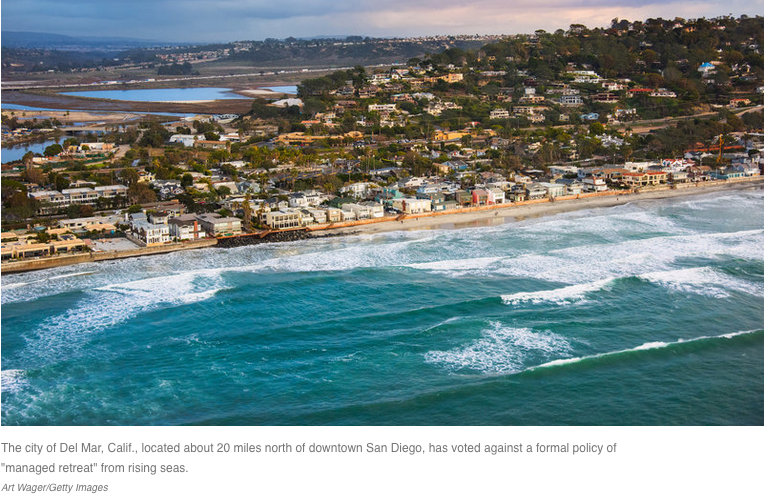
Related: 'Retreat' Is Not An Option As A California Beach Town Plans For Rising Seas: NPR

hurricanes, #searise, #bushfires, property values, insurance, #America, #Australia, #Houston, #wildfire,  

Friday, 4 September 2020

The Carbon Club/Book: 'You bastards sacked me.' (excerpt): SMH

climate change denial
The Carbon Club
How did environmental issues become so politicised? The people purge early in the Abbott government – beginning in 2013 with the "night of the short knives" – gives some clues.

By Marian Wilkinson

"What surprised the scientists most was not their hasty sacking but how quickly the government obliterated their work. “The website that we’d spent a lot of time building was taken down with absolutely no justification as far as I could see,” says Flannery, the one-time principal research scientist at the Australian Museum and internationally renowned scientific author. “It was giving basic information that was being used by many, many people – teachers and others – just to gain a better understanding of what climate science was actually about.”

climate change denial
Corruption
The Climate Commission had been set up in 2011 by Julia Gillard’s Labor government as an independent source of information for the public to understand climate change and its impacts on Australia. But the commission and its members had been pilloried as “alarmist” by sceptical columnists in the Murdoch media and by radio shock jocks from the beginning. Flannery was expecting the commission to be disbanded, but the decision to kill its website hurt."

..............................


climate change denial
We Want Climate Action Now

"Not long before this, the Liberal Party’s donor cash cow, the Cormack Foundation, which Morgan chaired, had stumped up another $300,000 for the Institute of Public Affairs. The conservative think tank’s latest publication, Climate Change: The Facts 2014, was soon in the works with essays from Australia’s best known climate sceptics, News Corp’s Andrew Bolt and former James Cook University professor Bob Carter, along with their international cohorts by now so familiar here: MIT’s Professor Richard Lindzen, Dr Pat Michaels from the US Cato Institute – a think tank co-founded by American billionaire Charles Koch – and the former UK chancellor Nigel Lawson.

climate change denial
Climate Justice
At the same time as Morgan’s attack, Lawson’s UK think tank, The Global Warming Policy Foundation, welcomed Abbott’s old mentor, John Howard, to deliver its annual lecture in London. The former Liberal prime minister used the opportunity to enthusiastically back Abbott’s plan to dismantle Labor’s climate policies in a speech he called “One Religion is Enough”."

..............................


"By the end of Abbott’s first year in office, the PM had made it clear he didn’t believe most climate scientists, even those who worked for his government. But while his climate scepticism could shape policy in Canberra, it would soon put him in conflict with the most powerful leader in the world, US president Barack Obama.

This is an edited extract from Marian Wilkinson’s The Carbon Club (Allen & Unwin, $33), out Monday."


Related:   MAJOR PARTIES LEAVE BACKDOOR OPEN FOR DIRTY DONATIONS


Abbott-Turnbull-Morrison Government, carbon emissions, corrupting donations, Institute of Public Affairs IPA, Koch brothers, Murdoch media, political party donations from corporations, Professor Flannery


MAJOR PARTIES LEAVE BACKDOOR OPEN FOR DIRTY DONATIONS


The Greens condemn the major parties for voting to create a backdoor for dirty donors to bypass state donations laws.

Greens Leader in the Senate and spokesperson for Democracy, Senator Larissa Waters, said:

“Once again, we see the major parties going to every length to keep the dirty donations flowing to their coffers.

“These new laws allow donors to bypass state donations laws. If we leave this backdoor wide open, we will see big money flowing to state parties under the guise of ‘federal purposes’.

“Thanks to pressure from the Greens, Queensland Labor has banned the corrupting influence of donations from property developers. Yet both Labor and the Libs just voted for laws that will undermine those protections."

Labor sided with the government to oppose Greens amendments that would have lowered the disclosure threshold, capped donations at $1,000 each year, and stopped all donations from industries - such as mining, banking, and gambling - with a track record of trying to buy political outcomes.

“We had a chance today to stop corporations from buying their seats at the table; but the big parties remain all too willing to sell democracy to the highest bidder,” Senator Waters said.

“Corporate money should have no place in parliament. It’s time the government cleaned up legalised corruption and put public need ahead of party greed.”


03.09.2020

Carbon tariffs: an instrument for tackling climate change?: AXA

Carbon Tariffs: Another Name for Green Protectionism?

A Carbon Tariff model that might be acceptable to developing countries

Carbon tariffs are a tax on carbon-intensive imports, which recently triggered heated international debates. Certain industrialized countries have been advocating the adoption of carbon tariffs on products imported from developing countries, such as China. 

According to Marco Springmann, a physicist turned economist, the main reason is that certain rich nations have implemented binding targets to reduce greenhouse gas emissions, while poorer countries have so far resisted legal commitments. Additionally, because many of them simply do not set a price on carbon, they can produce cheaper carbon-intensive goods. Promoters of carbon tariffs thus think that taxing such goods at the border will make up for this difference in price and indirectly regulate the associated emissions.

However, almost a quarter of China’s CO2 emissions come from its

exports. So China and other nations view carbon tariffs as trade sanctions and protectionism. They even threatened to start a “trade war” if such schemes were to be put into place. They stress the role that carbon emissions have played in the industrialization of advanced economies and demand increased financial aid in order to reduce their emissions.

Carbon tariffs to finance clean development

To avoid this coming carbon war, Springmann proposes to recycle the tax revenues from carbon tariffs (claimed in the importing country) to the exporting country as investments in climate change mitigation and adaptation measures. This coupled scheme addresses the concerns about competitiveness and reducing emissions in one part of the world and economic progress in the other. Since it acknowledges the demand for imports as an emissions-causing factor, it may therefore represent a consensus solution within a global climate policy. According to Springmann, a preliminary assessment has indicated that the revenue from this scheme would range between $8 and $50 billion per year, depending on the price of carbon. In comparison, at the climate summit in Copenhagen in 2009, it was agreed to create a “Fast Start Fund” to support climate adaptation and clean technology in developing countries. The pledged contribution is $30 billion over the next three years. Carbon tariffs would add significant revenue streams to this effort."

Go to original AXA article by Marco Springmann (3 years)


 Related: Young people’s burden: requirement of negative CO2 emissions: Hansen et al


carbon tariffs, carbon footprint, impose trade tariffs on carbon offenders, carbon trading, climate catastrophe, #economy,

Thursday, 3 September 2020

'A shot in the arm:' Victoria backs clean energy in bid to fuel COVID-19 recovery: SMH

(Pics by this blog)

"Clean energy projects will receive a Victorian government funding boost in the hope of driving the state's battered economy out of the coronavirus downturn and avoiding a slump in wind and solar investment.

Victorian Energy Minister Lily D'Ambrosio is preparing to brief 


300 investors on Wednesday about the launch of a formal process to test interest in building 600 megawatts of renewable energy capacity statewide, which she said would drive down prices and create new jobs at a critical time."

.......................................

"Climate advocates say the unprecedented upheaval of COVID-19 presents a once-in-a-generation opportunity to accelerate the energy transition. Mr Thornton said there was now a "massive consensus" in Australia and around the world about the potential for renewable energy to play a leading role in the economic recovery from COVID-19."

By Nick Toscano and Miki Perkins

Go to the complete SMH article 


Related: 

Young people’s burden: requirement of negative CO2 emissions: Hansen et al