Tuesday, 8 September 2020

South Africa's Climate Action Rating by the 'Climate Action Tracker' (Excerpt)

At the Climate Action Tracker site countries are evaluated according to the sufficiency of climate action.
Check out your country at the site.

(Excerpt- Pics by this blog)

"At 2 Dec 2019     Rating: Highly Insufficient"

"The South African government finally approved its Integrated

Resource Plan (IRP2019) in October 2019, confirming the trend change in power sector planning indicated in the draft for comment from August 2018. The plan reduces the role of coal compared to previous planning and increases the adoption of renewables and gas. Unlike earlier drafts, the IRP2019 proposes extending the operational lifetime of South Africa’s sole nuclear power plant by 20 years, up to 2044.

The final plan marks a major shift in energy policy, which is remarkable for a coal-dominated country like South Africa. It aims to decommission over 35 GW (of 42 GW currently operating) of coal-fired power capacity from state-owned coal and utility giant Eskom by 2050.

remarkable for a coal-dominated country like South Africa.
Coal in South Africa - Wikipedia
However, it would still see South Africa complete nearly 6 GW of costly coal capacity currently under construction and commission another 1.5 GW of new coal capacity by 2030. IRP2019 includes a detailed phase-out plan for coal-fired power plants, which, despite improvements to earlier plans, still shows that substantial amounts of coal capacity will run beyond the year 2050. For Paris-compatibility, coal must be phased out globally, at the very latest by 2040.

The plan also proposes a significant increase in renewables-based generation from wind and solar as well as gas-based generation capacity by 2030 (an additional 15.8 GW for wind, 7.4 GW for solar and 2.5 GW for gas by 2030), with no further new nuclear capacity being procured.

Implementing the IRP2019 will enable South Africa to achieve its 2030 NDC target. However, we rate South Africa’s NDC target as “Highly Insufficient” based on the upper end of the NDC range. In this context, South Africa should consider revising its target downward for 2030 to be resubmitted to the UNFCCC as part of the Paris Agreement’s ambition raising cycle of 2020.

To be in line with the Paris Agreement goals, South Africa would need to adopt more ambitious actions by 2050 beyond the IRP2019, such as even further increasing renewable energy capacity by 2030 and beyond, fully phasing out coal-fired power generation by latest 2040, and substantially limiting natural gas use.

Although South Africa is one of the few countries that has put forward absolute emissions targets in their NDC, we still rate this target “Highly Insufficient”.  ..........................


Go to Climate Action Tracker for more detail.

Related: This is what sea level rise will do to coastal cities: Video


...and in Australia: "While the federal government continues to repeatedly state that Australia is on track to meet its 2030 target “in a canter”, the Climate Action Tracker is not aware of any scientific basis, published by any analyst or government agency, that would support this. The OECD has warned the Australian Government that it will not achieve its target without intensified mitigation efforts. It describes current climate policy as a “piecemeal approach”." Climate Action Tracker

#climateaction, coal mining, South Africa, Paris Agreement, Paris Targets, #renewables,

Monday, 7 September 2020

Climate Change Poses Serious Threats to India's Food Security (excerpt): The Wire

Climatic factors like increased temperatures and extreme rainfall will affect productivity by causing physiological changes. Photo: Reuters
"Planning for the long-term impacts of climate change on agriculture appears to be rather low on the government's priority list.

Issues including the security clampdown in the Valley and slowdown in major sectors of the economy are dominating headlines. The agriculture ministry too would be occupied with formulating interventions to spur the economy of the erstwhile state of Jammu and Kashmir.


Climate change is no longer a distant threat. According to the Indian Meteorological Department, the annual mean temperature in the country has increased by 0.6 degrees Celsius between 1901 and 2018, when compared to pre-industrial levels. Eleven of the 15 warmest years have so far all been within the last 15 years with 2018 being the sixth warmest year in India’s recorded history.

The extent and degree of warming are going to get more severe. As carbon emissions continue and those which are built into the climate system take effect, temperatures across the world are expected to increase between 3-5 degree Celsius by 2100. India is among the countries which are likely to bear the worst of a warming planet due to its tropical location and relatively lower levels of income.

Agriculture and food production are likely to be significantly affected by climate change. According to one estimate, yields of major crops could decline by up to 25%. A recent IPCC report also warned that in the years to come, food security will stand threatened due to climate change coupled with increasing demands of the rising population.

The global population is expected to increase from 7.7 billion in 2019 to 8.5 billion by 2030 and 9.7 billion by 2050. According to the United Nation’s World Population Prospects (June 2019), the Indian population is projected to increase from 1.36 billion in 2019 to 1.5 billion by 2030 and 1.64 billion by 2050.

Crops, animal husbandry, as well as fisheries,
 are likely to be impacted. Photo: Reuters

Providing food and nutritional security to an entire population needs some serious planning and effective implementation. And we need to start now. 

Climatic factors like increased temperatures and extreme rainfall will affect productivity by causing physiological changes. In addition, they will affect soil fertility, the incidence of pest infestation and the availability of water. This will impact crops, animal husbandry as well as fisheries."................................

From The Wire 
by Siraj Hussain
19/Sep/2019

Book: What Can I Do? by Jane Fonda: ‘If Greta Thunberg can do it, so can I’ (excerpt): The Guardian

the actor recalls the beginnings of her climate crisis protests outside the White House
Jane Fonda, actor and climate activist
"There was a long silence, and then she said, “Well, Jane, that’s wonderful and I’m blown away that you’re ready to put yourself out there like that, but you can’t camp overnight in Washington. It’s illegal since Occupy Wall Street camped there. But let’s figure out what is possible.” She offered to set up a conference call with her, Bill McKibben, co-founder of 350.org, Naomi Klein, the environmental lawyer Jay Halfon, and me. Bill suggested a once-a-week protest that involved civil disobedience. Fridays had been claimed by Greta Thunberg and the student climate strikers, but the youth had also called on adults to join them. “Maybe you could do an action on Fridays as well.”

I’d been getting ready for this my whole adult life – a weekly
An extract from Jane Fonda's book
Jane Fonda climate activist
action that culminated in nonviolent civil disobedience. And I wouldn’t have to worry about pooping. I began planning for the maximum time I could spend in DC before I had to get ready to film our last season of Grace And Frankie on 27 January 2020. It added up to four months, 14 Fridays."


What Can I Do? by Jane Fonda is published by HQ, at £20. To order a copy for £17.40, go to guardianbookshop.com. Delivery charges may apply.
 

Go to The Guardian's article 

Related: 'The Future We Choose', Book by Christiana Figueres & Tom Rivett-Carnac

‘Climate Donors’ Flock to Biden to Counter Trump’s Fossil Fuel Money (excerpt): New York Times

(Pics by this blog)
Democratic donors “want action” on fossil fuels
Koch Industries are behind Trump

WASHINGTON — In 2009, the Obama administration’s environmental team called a group of climate activists to the White House to deliver a message: Climate change doesn’t sell and only provokes economic attacks from the right that are too difficult to counter.

As former Vice President Joseph R. Biden Jr. prepares to assume the Democratic Party’s presidential nomination, the changing climate is now a core campaign issue — and a focus for fund-raising. Plans for tackling rising global temperatures will be in the spotlight Wednesday at the Democratic convention. And Mr. Biden has raised more than $15 million in candidate contributions from hundreds of new donors who specifically identify with climate change as a cause.


Democratic donors “want action” on fossil fuels
Biden: Build Back Better

That climate-specific fund-raising may make up just about 5 percent of the total he has raised so far. It’s dwarfed by fossil fuel donations to President Trump, who took in $10 million from a single fund-raiser in June, held by the oil billionaire Kelcy Warren, and whose super PAC,America First Action, has seen millions pour in from coal and oil moguls, according to the Center for Responsive Politics, which tracks campaign donations.

It is not known how much unregulated money is going to super PACs aligned with Democrats from other self-identified climate donors.

But the hard money climate donations represent a growing counterweight to oil, gas and coal money that has long warped the
Democratic donors “want action” on fossil fuels
Biden and Harris at first joint campaign event.
energy conversation in Washington. Self-identified “climate donors” are a new phenomenon in the 2020 election and are working overtime to show candidates that campaigning to eliminate emissions from fossil fuels pays — in cash.

“That is a sea change. We’ve now got a class of people called ‘climate donors’ in a way we had environmental donors before,” said David Bookbinder, general counsel for the Niskanen Center, a nonpartisan think tank in Washington.

Democratic donors “want action” on fossil fuels
Trump's environmental rollbacks
Climate has taken over as an issue on its own. People are finally understanding that we have a truly existential crisis on our hands,” Mr. Bookbinder added. Publicly embracing climate change solutions was viewed as a political liability, as recently as a decade ago, he said. During Barack Obama’s re-election run in 2012, the issue was hardly mentioned.'

Now donors are sending a new message: “We want to make it easy to do the right thing. We should reward campaigns and candidates for having the right policies,” said Matt Rogers, a co-founder of the digital thermostat company Nest."  ............

"A version of this article appears in print on
Lisa Friedman
Aug. 19, 2020"


 Trump, Biden, Harris, #climatechange, fossil fuel industry, Koch brothers, political party donations from corporations, Democrats, Republicans, #jailclimatecriminals

Trump will roll back more environmental regulations if reelected, says EPA chief: CNBC

and lead to thousands of additional deaths from bad air quality
Koch industries fund Trump
 "Key Points
 
* President Trump will continue to weaken environmental regulations on industries if reelected in November, the EPA’s Andrew Wheeler told The Wall Street Journal. 

* The administration would establish a cost-benefit analysis of any new regulation and expand the use of “science transparency” to justify new regulations. 

* After three years in office, the administration sought to reverse
and lead to thousands of additional deaths from bad air quality
Politicians and Climate Change
more than 100 major environmental rules that it has deemed burdensome to the fossil fuel industry, even as climate change accelerates. 

* Analysts say many of the administration’s rollbacks could increase emissions and lead to thousands of additional deaths from bad air quality."
 
...........................
 
"Democratic presidential nominee Joe Biden has released a plan to put $2 trillion into green infrastructure and energy over four years to curb climate change and spur economic growth, which the Trump campaign has argued would hurt the oil and gas industry. "
 
Go to the CNBC article 

Published Thu, Sep 3 2020

Sunday, 6 September 2020

Trump and Biden: Little room for climate change in US election (excerpt): DW

68% of Democratic voters see climate change as high priority
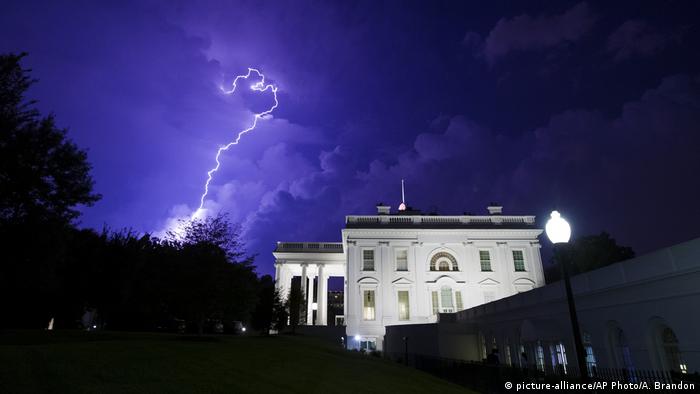
The White House
As the US faces wildfires and storms, climate change remains one of the most divisive topics among voters. Yet despite the high stakes, so far, it has played a minor role in the upcoming election. 

US President Donald Trump has undone many major pieces of climate policy during his term, walking out on the Paris Agreement to limit global warming and eliminating numerous Obama-era environmental regulations. 

However, climate change doesn't even make the top 10 concerns among registered voters, even as the US faces extreme weather from wildfires to storms, scientists say are more prevalent by global warming. It ranks 11th behind the economy, health care, Supreme Court appointments and the pandemic, according to a survey conducted by the Pew Research Center published in August. 

While climate doesn't top the voters' agenda, it's still one of the most divisive issues among Trump and Biden supporters. Some 68% of Democratic voters see climate change as high priority compared to 11% of Republicans, found the Pew survey. 


68% of Democratic voters see climate change as high priority
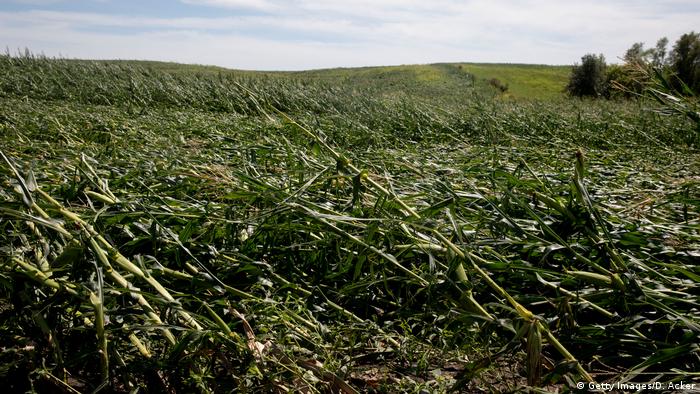
Following a storm in Iowa last month, estimates suggested that almost a third of the state's crop-growing land was affected
68% of Democratic voters see climate change as high priority
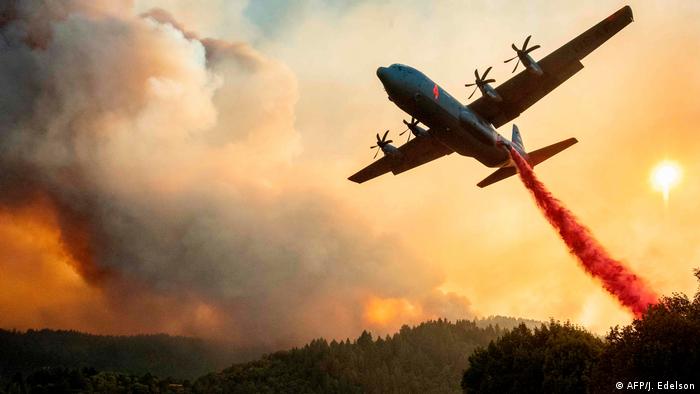
Wildfires are becoming more frequent in California, where the ground and vegetation has suffered from long, dry summers
But what are the Biden and Trump campaigns promising to do on climate change and the environment — and how does it tally with what voters want?

Go to complete DW article

 Related: Donald Trump is hampering fight against climate change, WEF warns (excerpt) : The Guardian (2 years ago)

Trump, Biden, #USA, USA, voters, #climate crisis, #climatecriminals, #jailclimatecriminals, 

Germany's coastal lowlands under the shadow of climate change: DW

predicted sea level rise
German mud flats in danger
"Much of Germany's North Sea coast is low enough to put it at risk from the waters at its door. Not least in an era of warming temperatures and predicted sea level rise."

"The wind whips threatening clouds across a dark blue sky above the North Frisian island of Pellworm. Petra Feldkamp casts a glance toward a high green dike in the near distance. Directly behind it, the sea rolls and roars. Out of sight, but not out of mind.

Particularly after a summer in which the realities of our warming global climate have been scorched into the German consciousness.
"I think we all take it seriously. When you live here, you see the situation, you feel it," says Feldkamp, whose family has been on the island for generations. "But this is a place of calm, so it doesn't really scare you."

Though she acknowledges that her sense of calm is in large part due to the protective dikes that were recently raised, and without which the island "would drown," she says she feels "totally safe."

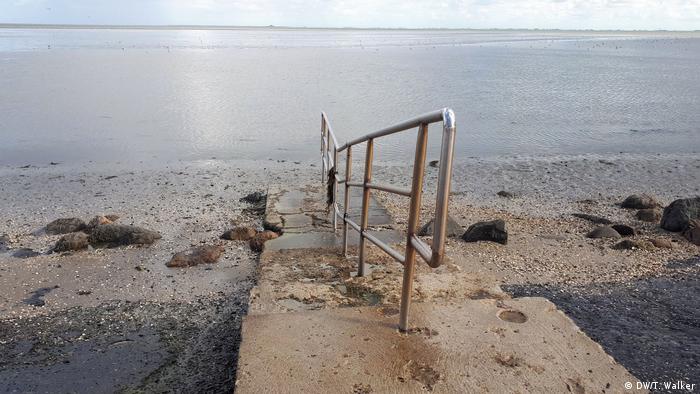
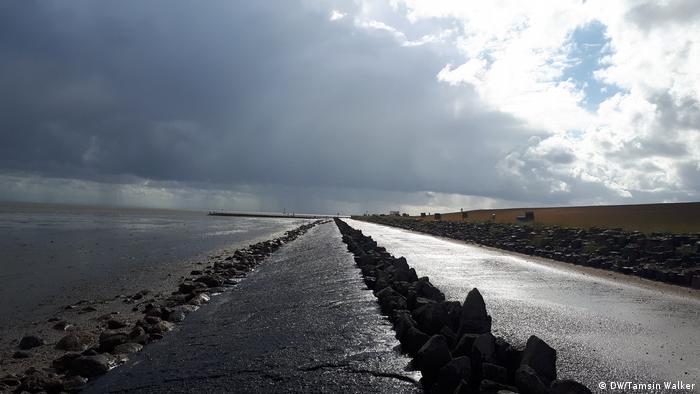
A railing and steps lead down to a calm sea (DW/T. Walker)
When the sea is calm, so is the sense of living alongside it.
For Thomas Langmaack of the northern state of Schleswig-Holstein's agency for coastal defense, national parks and marine conservation (LKN), that's a cause for concern.


Too close yet too comfortable

It is also his job to foster an understanding among communities inhabiting the 3,900 square kilometers (1,505 square miles) of lowland — some of which was originally sea snared over time through the construction of dikes — of the capricious and sometimes ferocious nature of the waters that swirl around them.

"People have largely become careless," Langmaack said. "They've suppressed it, because there hasn't been a devastating storm surge for several decades."

And because the several hundred kilometers of complex dikes form a wall between them and the sea, they are safer than ever before.

predicted sea level rise
Dikes are constantly being repaired and renewed

Dikes are constantly being repaired and renewed to enable the people to continue to live in the flatlands in relative safety
"But even they can fail," LKN spokesman Hendrik Brunkhorst said. "We have to make people aware of the dangers."

The sea rose only 28 centimeters (11 inches) between 1940 and 2007, which is in keeping with recordings from the previous century. But there is a sense of urgency about the need to prepare local communities for the worst, in part stirred by cyclone Xaver, which hit the region in 2013, but also because both sea and storm water levels are predicted to rise within the coming decades.

Planning for the unknown

Besides alerting the population, the agency for coastal defense has been strengthening its fortifications with so-called "climate dikes."

A far cry from the early hand-built clay incarnations that began appearing on the flat northern German landscape around a millennium ago, these precision-engineered giant green slopes are designed to keep the waves at bay in such a way that it would be easy to add a new layer on top if water levels were to suddenly rise much faster than current forecasts suggest.

"We have to look to the future," Langmaack said. "What we have is rising temperatures, and that means rising sea levels, but nobody can tell us how the curve is going to develop, and that makes it very difficult."

"We're genuinely planning for the next 100 years," he continued."

.......................

"As a conservationist, Fröhlich doesn't generally sanction the idea of tampering with nature, but climate change  induced sea level rise could, he says, be grounds enough for an exception.

"I think we underestimate what's around the corner," he said. "I'm worried that large parts of this area will be lost. I really am."

And if that happens, if the Wadden Sea starts to swallow itself, there's a very good chance the sense of calm it instills in those who live with and from it, will sink as well."

Go to the original, complete, 2018 DW article

Ref: Sea Level Rise and Implications for Low-Lying Islands, Coasts and Communities: IPCC

Related:  Related: East Antarctic Melting Hotspot Identified by Japanese Expedition – Ice Melting at Surprisingly Fast Rate: SciTechDaily