Tuesday, 25 August 2020

How Hard Is It to Quit Coal? For Germany, 18 Years and $44 Billion (excerpt): NYT

Germany also faces intense opposition to nuclear power.
 
Credit...Federico Gambarini/DPA/
Agence France-Presse — Getty Images
Germany announced on Thursday that it would spend $44.5 billion to quit coal — but not for another 18 years, by 2038.

The move shows how expensive it is to stop burning the world’s dirtiest fossil fuel, despite a broad consensus that keeping coal in the ground is vital to averting a climate crisis, and how politically complicated it is.

Coal, when burned, produces huge amounts of the greenhouse gas emissions that are responsible for global warming.

Germany doesn’t have shale gas, as the United States does, which
expensive it is to stop burning the world’s dirtiest fossil fuel
Resistance to the Adani Coal Mine in Australia
has led to the rapid decline of coal use in America, despite President Trump’s support for coal. Germany also faces intense opposition to nuclear power. After the Fukushima disaster in 2011, that opposition prompted the government to start shutting down the country’s nuclear plants, a transition that should be complete by 2022.

The money announced Thursday is to be spent on compensating workers, companies and the four coal producing states — three in the country’s east and one in the west. It followed months of negotiations between regional officials and Chancellor Angela Merkel’s government.

Germany’s timetable, though, could present challenges to the European Union’s efforts to swiftly cut its greenhouse gas emissions, as the bloc’s new leadership has announced. Countries around the world are watching how quickly the 28-country union, which, taken together is currently the third-largest emitter of planet-warming gases, can reduce its carbon footprint. Germany is the largest economy in the European Union.

Go to NYT article

Your Questions About Food and Climate Change, Answered: NYT

it’s a fine idea to reuse the bags that you do get, or to buy a reusable bag
The average greenhouse gas impact (in kilograms of CO2) of getting 50 grams of protein from:
An excellent article on the climate change impact of various diets. below are sample graphics. The actual site is interactive and packed full of information. The article concludes with some suggested recipes for a climate friendly diet.

Here are a few shots of the excellent article.

it’s a fine idea to reuse the bags that you do get, or to buy a reusable bag

Related: Recipes: Celebrate Sustainable Food for Planet A on our blog

it’s a fine idea to reuse the bags that you do get, or to buy a reusable bag

Does what I eat have an effect on climate change? 


Go to New York Times site

it’s a fine idea to reuse the bags that you do get, or to buy a reusable bag
Climate Friendly Recipes


Related: Recipes: Celebrate Sustainable Food for Planet A on our blog

The End of the Environment: Bob Brown.: The Saturday Paper (excerpt)

.... "The prime minister’s post-Covid-19 plan is to roar ahead with a slate of mega-projects that would be delayed by any
a boon for corporate environmental exploiters
Liberals and nationals Fail Australian Forests
proper consideration of their environmental and Indigenous heritage impacts.
 
 
While the EPBC Act rarely leads to any project being given the thumbs down, it does require environmental impacts to be assessed, and this takes time. The government’s solution? Get rid of the federal assessment.
 
a boon for corporate environmental exploiters
Forests are only proven carbon storage
When parliament resumes next week, Minister for the Environment Sussan Ley will introduce a bill, under the cover of Covid-19, to amend Howard’s EPBC Act and hand the power to the states – which are more vulnerable to the corporate sector – to approve mining, gas fracking, dam building, the rapid expansion of industrial fish farming and the invasion of national parks by private enterprise. She aims to wash her hands of the Commonwealth’s responsibility for environmental assessment and protection.
 
...........................
 
.........................
 
The minister is not waiting for the final report, due in October, of her own inquiry into the EPBC Act, headed by businessman Graeme Samuel. Last month she peremptorily dismissed his interim report’s key recommendation that the Commonwealth set up a policing agency to watch over state management of environmental matters. This was despite Samuel’s finding that “Australia’s natural environment and iconic places are in an overall state of decline and are under increasing threat”.
 
Undoubtedly, the powers to protect Indigenous heritage will be the
a boon for corporate environmental exploiters
Koala after wildfire
next thing shunted to the states. Ley knew the Juukan Gorge caves were to be blown up by Rio Tinto before the event and yet she did nothing. Next, she rejected national heritage protection for the ancient Djab Wurrung eucalypts in Victoria. Handing her powers to the states will spare her from such complicit embarrassment in the future.
 
a boon for corporate environmental exploiters
Australia's climate action record
With the Greens opposed, it will be up to Labor and the crossbenchers in the senate to take on Scott Morrison’s game plan to relegate environmental powers to weaker state governments while concentrating economic might in Canberra: a boon for corporate environmental exploiters and their lobbyists in both cases.
 
This is a watershed moment for Australia’s environment. It has taken more than two decades to see any success in our fight to chip away at Howard’s RFAs. And now we face another era wherein policy is being devised to ignore the certainty of environmental devastation for the promise of a quick profit.
 
In Earth’s sixth great age of extinction, there is a rising tide of opposition to the foolishness, if not criminality, of destroying wildlife habitats – from the deep seas to coral reefs and coastlines to what little is left of woodlands, grasslands and forests.
 
a boon for corporate environmental exploiters
Koala and destroyed forest
The phenomenon of Extinction Rebellion, temporarily quietened by Covid-19, is just a hint of the public unrest to come unless the needless exploitation of nature and our finest human heritage ends. Earth’s ecosystem is at breaking point. Our human herd is already using nearly twice the living produce this planet is capable of sustaining and yet, everywhere, the clamour is for “growth”.
If the forests continue to fall, everything else will follow. As with whaling in 1978, the time for logging Australia’s wildlife-filled and carbon-rich native forests is up.
 

CLIMATE CHANGE, FOOD SECURITY, AND AGROBIODIVERSITY: C.G. Gonzalez

"CLIMATE CHANGE, FOOD SECURITY, AND AGROBIODIVERSITY: TOWARD A JUST, RESILIENT, AND SUSTAINABLE FOOD SYSTEM Carmen G. Gonzalez* 

The global food system is in a state of profound crisis
Climate change will cause more food shortages

 
The global food system is in a state of profound crisis. Decades of misguided aid, trade, and production policies have generated record levels of world hunger despite bountiful harvests and soaring profits for the transnational corporations that dominate the global food supply. The rapid expansion of industrial agriculture has produced an unprecedented loss of plant genetic diversity,  making the world's food supply dangerously vulnerable to wide-spread crop failure akin to that of the Irish potato famine.  In addition, climate change threatens to wreak havoc on food production by increasing the frequency and severity of extreme weather events, depressing agricultural yields, reducing the productivity of the world's fisheries,  and placing additional pressure on scarce water resources. 

* Professor of Law, Seattle University School of Law
 .............
 
The global food system is in a state of profound crisis
sustainable food systems

This Article examines the underlying causes of the global food crisis and recommends specific measures to address the distinct but related problems of food insecurity, loss of genetic resources, and climate change." 

Go to the scholarly article by Carmen g. Gonzalez


Related:
The global food system is in a state of profound crisis
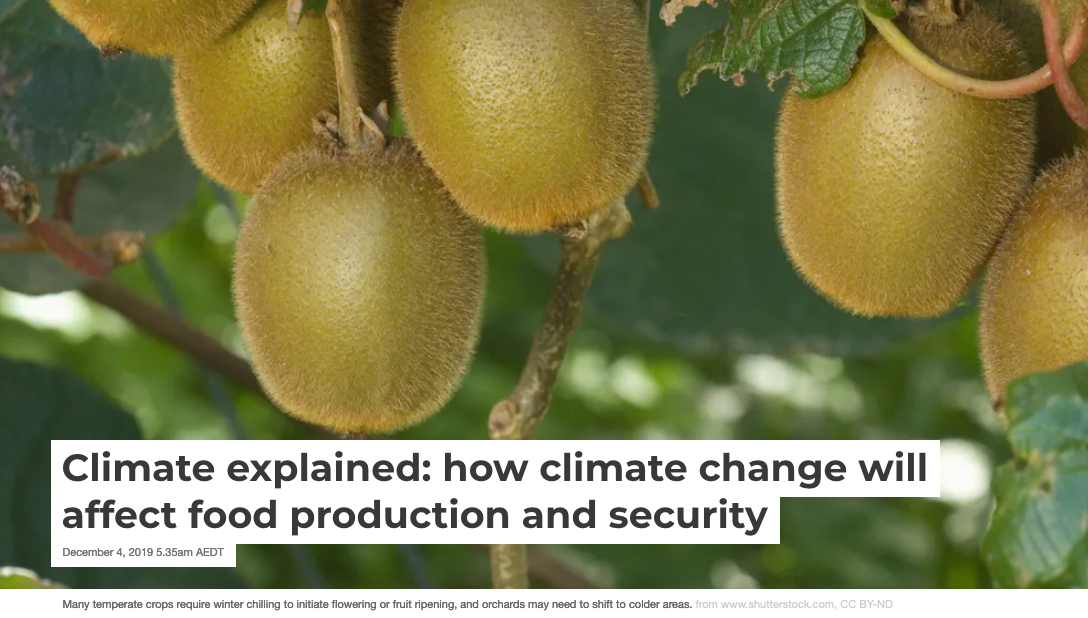
Chilling requirements for food crops

 Related:  9 Ways to assist Australia's farmers with climate change


The global food system is in a state of profound crisis
Some Costa Rican forests returned after removing cattle farming subsidies


Monday, 24 August 2020

Polar bears, climate crisis, and oil and gas drilling in the Arctic National Wildlife Refuge: WWF site (excerpt)


Identify areas where  cute polar bear cubs can live on solid Arctic sea ice
Polar bear cubs at risk from climate change
"Sea levels are rising and oceans are becoming warmer. Longer, more intense droughts threaten crops, wildlife and freshwater supplies. From polar bears in the Arctic to marine turtles off the coast of Africa, our planet’s diversity of life is at risk from the changing climate."

"Climate change poses a fundamental threat to the places, species and people’s livelihoods WWF works to protect. To adequately address this crisis we must urgently reduce carbon pollution and prepare for the consequences of global warming, which we are already experiencing. WWF works to:
  • advance policies to fight climate change
  • engage with businesses to reduce carbon emissions
  • help people and nature adapt to a changing climate"


"Humans and wild animals face new challenges for survival because of climate change. More frequent and intense drought, storms, heat waves, rising sea levels, melting glaciers and warming oceans can directly harm animals, destroy the places they live, and wreak havoc on people’s livelihoods and communities."


Humans and wild animals face new challenges for survival because of climate change

Polar bears, climate crisis, and oil and gas drilling in the Arctic National Wildlife Refuge


"To adequately address the climate crisis we must urgently reduce carbon pollution and prepare for the consequences of global warming, which the world is already experiencing. Combining global outreach with local expertise, WWF:
  • helps people and nature adapt to a changing climate
  • advances policies to fight climate change
  • combats deforestation
  • engages with businesses to reduce carbon emissions
  • challenges U.S. cities to prepare for more extreme weather"


"Adapting to Climate Change


To avoid the worst effects of climate change, we need to dramatically reduce global carbon emissions. But we must also prepare for the significant and unavoidable consequences of carbon
Identify areas where polar bears can live on solid Arctic sea ice for decades to come
polar bear cubs
emissions such as increasing temperatures, shifting precipitaton patterns, ocean acidification, sea level rise and the increasing intensity and frequency of extreme weather events. WWF works with local communities, governments and others around the world to help nature and people prepare for the many impacts of a changing climate. To do this we:

  • Increase resilience of communities in Nepal by promoting new farming techniques, community weather monitoring and creating seed banks
  • Restore beach vegetation to shade marine turtle nests in the Caribbean
  • Secure access to fresh water for elephants in Thailand during periods of drought
  • Identify areas where polar bears can live on solid Arctic sea ice for decades to come"
 Go to WWF site
 Related: Brazil slashes budget to fight climate change as deforestation spikes: Reuters

The Two Sides to Canada’s Post Pandemic Recovery: by Rolly Montpellier @Below2C

There are two sides to Canada’s post pandemic recovery. On the bright side there’s massive public support for a recovery that puts people before profits and tackles both the climate crisis and the coronavirus crisis simultaneously. Hundreds of organizations all across the land have endorsed these Just Recovery Principles. But there is also a dark side.

The Two Sides to Canada's Post Pandemic Recovery, Below2C
Canada's commitment to different energy types since beginning od Covid 19 pandemic


1. The Dark Side

“The last time we had a financial meltdown (the 2008-09 recession) it was followed by a record surge in fossil fuel burning,” wrote Barry Saxifrage and Chris Hatch recently in the National Observer
 “At the time there was hope that governments would use their huge, future-shaping stimulus to transition to a climate-safe economy.”

Fossil Fuel Burning Annual Totals


Well, that didn’t happen. Instead, the burning of fossils soared in 2010 and continued its upward trajectory every single year since. That is, until the pandemic as the Global Fossil Fuel Burning chart illustrates. The blue dotted line on the chart shows the projection for an 8% decline in CO² for 2020.

The Observer view on the climate catastrophe facing Earth : The Guardian


"Thirty years ago we were warned. Now is our last chance to listen
 
warned the authors of the first assessment report of the IPCC
Climate Catastrophe

Thirty years ago this week, the population of Earth was given official notification that it faced a threat of unprecedented magnitude. Emissions of carbon dioxide and other greenhouse gases, spewed into the atmosphere from factories and vehicles burning fossil fuels, were pinpointed, definitively, as triggers of future climate change. 

Melting icecaps, rising sea levels and increasing numbers of extreme weather events would be the norm for the 21st century unless action were taken, warned the authors of the first assessment report of the Intergovernmental Panel on Climate Change (IPCC).

The scientists had been charged by the IPCC, which had been set
warned the authors of the first assessment report of the IPCC
When Arctic Ice Melts
up two years earlier, with establishing whether climate change was a real prospect and, if it was, to look at the main drivers of that threat. They concluded, in a report released in August 1990, that the menace was real and that coal, gas and oil would be the principal causes of global heating. Unless controls were imposed on their consumption, temperature rises of 0.3C a decade would be occurring in the 21st century, bringing havoc in their wake."


Go to complete story of The Guardian 

 Related: There is an answer to post Covid-19 economic chaos.

UN Intergovernmental Panel on Climate Change (IPCC), IPCC report, #climate crisis, #cambio-climatico, #climatecriminals, #jailclimatecriminals,