Thursday, 10 September 2020

Aussie invention could save old coal stations by running them on zero-emissions ‘Lego’ blocks (excerpt): The Conversation


(MGA), stores energy in the form of heat
Miscibility Gap Alloy (MGA)
"As climate change worsens, the future of fossil fuel jobs and infrastructure is uncertain. But a new energy storage technology invented in Australia could enable coal-fired power stations to run entirely emissions-free.
The novel material, called miscibility gap alloy (MGA), stores energy in the form of heat. 


MGA is housed in small blocks of blended metals, which receive energy generated by renewables such as solar and wind.


(MGA), stores energy in the form of heat
MGA
The energy can then be used as an alternative to coal to run steam turbines at coal-fired power stations, without producing emissions. Stackable like Lego, MGA blocks can be added or removed, scaling electricity generation up or down to meet demand.

MGA blocks are a fraction of the cost of a rival energy storage technology, lithium-ion batteries. Our invention has been proven in the lab – now we are moving to the next phase of proving it in the real world."
............................................

"If our electricity grid is to become emissions-free, we need an energy storage option that’s both affordable and versatile enough to be rolled out at massive scale - providing six to eight hours of dispatchable power every night. 
 
MGAs store energy for a day to a week. This fills a “middle” time frame between batteries and hydro-power, and allows intermittent renewable energy to be dispatched when needed."


Related:  'The Future We Choose', Book by Christiana Figueres & Tom Rivett-Carnac

miscibility gap alloy (MGA), energy, coal, #methanegas, #Australia, batteries, #jailclimatecriminals, video,

Wednesday, 9 September 2020

COVID-19 can be an historic turning point in tackling the global climate crisis: UK Committee on Climate Change

(Pics from this blog)  

 If only the current Australian government would take advice like this. This is from the United Kingdom's Committee on Climate Change to the U.K. government in 2020.

1. Low-carbon retrofits and buildings that are fit for the future.
Climate Action Now
 "Ministers must seize the opportunity to turn the COVID-19 crisis into a defining moment in the fight against climate change, the Committee on Climate Change (CCC) says today.
 

In its annual report to Parliament, the Committee provides comprehensive new advice to the Government on delivering an economic recovery that accelerates the transition to a cleaner, net-zero emissions economy and strengthens the country’s resilience to the impacts of climate change.

1. Low-carbon retrofits and buildings that are fit for the future.
Cities might become unbearable.
Important steps have been taken in the last year, but much remains to be done. For the first time the Committee sets out its recommendations government department by government department. These are the urgent steps that must be taken in the months ahead to initiate a green, resilient COVID-19 recovery. 

They can be delivered through strong coordination across Whitehall. Doing so will propel the UK towards more rapid climate progress and position the country as an international climate leader ahead of the pivotal COP26 climate summit in Glasgow next year.

CCC Chairman, Lord Deben, said: “The UK is facing its biggest economic shock for a generation. Meanwhile, the global crisis of climate change is accelerating. We have a once-in-a-lifetime opportunity to address these urgent challenges together; it’s there for the taking. The steps that the UK takes to rebuild from the COVID-19 pandemic can accelerate the transition to a successful and low-carbon economy and improve our climate resilience. 

Choices that lock in emissions or climate risks are unacceptable.”


1. Low-carbon retrofits and buildings that are fit for the future.
Climate Change is a fact
Chair of the CCC’s Adaptation Committee, Baroness Brown of Cambridge, said: “COVID-19 has shown that planning for systemic risks is unavoidable. We have warned repeatedly that the UK is poorly prepared for the very serious impacts of climate change, including flooding, overheating and water shortages. Now is the moment to get our house in order, coordinate national planning, and prepare for the inevitable changes ahead. The UK’s domestic ambition can be the basis for strong international climate leadership, but the delivery of effective new policies must accelerate dramatically if we’re to seize this chance.”

The Committee’s new analysis expands on its May 2020 advice to the Prime Minister in which it set out the principles for building a resilient recovery. In its new report, the Committee has assessed a wide set of measures and gathered the latest evidence on the role of climate policies in the economic recovery. Its report highlights five clear investment priorities in the months ahead:

1. Low-carbon retrofits and buildings that are fit for the future.

1. Low-carbon retrofits and buildings that are fit for the future.
Hydrogen energy still requires research and development
There are vital new employment and reskilling opportunities across the country if Governments support a national plan to renovate buildings and construct new housing to the highest standards of energy and water efficiency, to begin the shift to low-carbon heating systems, and to protect against overheating. Roll-out of ‘green passports’ for buildings and local area energy plans can begin immediately. 

2. Tree planting, peatland restoration, and green infrastructure. Investing in nature, including in our towns and cities, offers another quick route to opportunities for highly-skilled employment, and outcomes that improve people’s lives. By making substantial changes in our use of land, which are needed to meet the UK’s Net Zero target, we will bring significant benefits for the climate, biodiversity, air quality, and flood prevention.

1. Low-carbon retrofits and buildings that are fit for the future.
Land ice is melting
3. Energy networks must be strengthened for the net-zero energy transformation in order to support electrification of transport and heating. Government has the regulatory tools to bring forward private sector investment. New hydrogen and carbon capture and storage (CCS) infrastructure will provide a route to establishing new low-carbon British industries. Fast-tracked electric vehicle charging points will hasten the move towards a full phase out of petrol and diesel cars and vans by 2032 or earlier.

4. Infrastructure to make it easy for people to walk, cycle, and work remotely. Dedicated safe spaces for walking and cycling, more bike parking and support for shared bikes and e-scooters can help the nation get back to work in a more sustainable way. For home working to be truly a widespread option, resilient digital technology (5G and fibre broadband) will be needed.

5. Moving towards a circular economy. Within the next five years, we can not only increase reuse & recycling rates rapidly but stop sending biodegradable wastes to landfill. Local authorities need support to invest strategically in separated waste collections and recycling infrastructure and to create new regional jobs.

There are also opportunities to support the transition and the recovery by investing in the UK’s workforce, and in lower-carbon behaviours and innovation:


1. Reskilling and retraining programmes. The net-zero economy will require a net-zero workforce, able to install smart low-carbon heating systems and to make homes comfortable; to design, manufacture and use low-carbon products and materials; and to put carbon back, rather than taking carbon out, from under the North Sea. Now is the time to build that workforce and to equip UK workers with vital skills for the future.

1. Low-carbon retrofits and buildings that are fit for the future.
Our children want answers.
2. Leading a move towards positive behaviours. There is a window for Government to reinforce the ‘climate-positive’ behaviours that have emerged during the lockdown, including increased remote working, cycling and walking. The public sector must lead by example by encouraging remote working. It also needs to innovate in order that customer service can be provided effectively remotely.

3. Targeted science and innovation funding. Kick-starting research and innovation now in low-carbon and adaptation technologies will facilitate the changes needed in the decades ahead and build UK competitive advantage. The COVID-19 crisis has highlighted the importance of research if we are to understand fully the threats and learn how to manage them.

1. Low-carbon retrofits and buildings that are fit for the future.
Cities must retreat from the coast.
Achieving the UK’s climate goals and rebuilding the economy fit naturally together. Each makes the other possible. Success demands that we do both. The actions recommended by the CCC will deliver an improved economy, better public health, improved biodiversity and access to nature, cleaner air, more comfortable homes and highly productive and rewarding employment."

Related:   Climate change: How the UK contributes to global deforestation (excerpt): BBC


#economy, #heatwaves, Britain, cities, COVID-19, energy, England, floods, infrastructure damage, reskilling, science, tidal flooding, United Kingdom

Trump and Biden: Little Room for Climate Change in 2020 Election (excerpt 2): Deutsche Welle

The last generation who can do something about climate change
Trump digs coal.
(Pics by this blog)

"U.S. President Donald Trump has undone many major pieces of climate policy during his term, walking out on the 2015 Paris Agreement to limit global warming and eliminating numerous Obama-era environmental regulations. 

 Trump's Democratic opponent, Joe Biden, has promised as part of his presidential campaign to invest $1.7 trillion in a "clean energy revolution and environmental justice" over the next decade. It falls some $14 trillion short of what the progressive U.S. senator from Vermont, Bernie Sanders, pledged on climate action during the Democratic primaries.........................."

...............................................................................................................................................................

Related:  Trump will roll back more environmental regulations if reelected, says EPA chief: CNBC
..........................................................................................................

"......  Growing Impatience Among Young Republicans

Some younger Republicans are starting to become critical of their party's inattention to climate change. During the recent Republican National Convention, a small group turned to Twitter during the online event, to ask "#WhatAboutClimate"?

Another Pew study from June 2020 found that millennial and Gen Z Republicans, currently aged 18 to 39, are more likely than older GOP voters to think humans have a significant impact on the climate and that the federal government is doing too little to tackle the problem.

The last generation who can do something about climate change Trump and climate


That doesn't mean they're ready to switch allegiance to the Democrats, though. 

"Being a Republican is very much rooted in my upbringing," said Kiera O'Brien, who founded the group Young Conservatives for Carbon Dividends (YCCD). "Conservatism at home in Ketchikan, Alaska, has a focus on community and nature." 

O'Brien dislikes the Democrat's "regulatory approach to climate" and is instead lobbying for free market solutions to climate change through YCCD.

The last generation who can do something about climate change
Biden and climate change

Reframing Climate Action  

Environmental policies can be a complicated issue when it comes to federal elections and hard to address for presidential candidates. Many regions in the U.S. have unique challenges: from wildfires in California and storms wiping out harvests in Iowa to water pollution in Flint, Michigan.

Harvard's Ansolabehere also pointed out that opposition to climate policies in the past were typically connected to the fear of losing jobs and that prohibiting coal or retooling the auto industry will "adversely affect employment" in places like Kentucky and Michigan.

The last generation who can do something about climate change
How Climate Change is Killing Us: Book
Daron Shaw added that Republicans typically "try to frame environmental issues as a matter of high taxation and job killing proposals with the hope that they can peel off Democrats."

Biden might be trying to assuage fears that tackling climate change means job losses by framing his plan as an opportunity for employment in new industries and a reinvigorated green manufacturing sector.

But when it comes to the swing states of Pennsylvania, Virginia and Ohio, Trump's climate record and support for jobs in the fossil fuel sector might give him the upper hand. His backing for ethane cracker plants, which take natural gas and converts it into the basis for making plastics, has received a lot of support, said Ansolabehere, especially from local unions. 

Go to original article.. By Julia Mahncke in Deutsche Welle 

The last generation who can do something about climate change


Related:  Trump will roll back more environmental regulations if reelected, says EPA chief: CNBC

Biden, Trump, #climateaction, Republicans, #methanegas, jobs, Paris Targets, Paris Agreement, 

Water wars: How conflicts over resources are set to rise amid climate change: World Economic Forum

global warming is increasing competition for water around the world
Water shortages for one in four children in areas of extreme water shortage by 2040

   • From erratic rainfall to severe droughts, global warming is increasing competition for water around the world, with water-related conflicts on the rise.
 
  • According to the WRI, more than two billion people live in countries experiencing "high" water stress.
 
  • Conserving forests, wetlands and watersheds, including those around cities, can help absorb rainfall, helping stem crop losses from flooding and drought.

From Yemen to India, and parts of Central America to the African Sahel, about a quarter of the world's people face extreme water shortages that are fueling conflict, social unrest and migration, water experts said on Wednesday.
With the world's population rising and climate change bringing more erratic rainfall, including severe droughts, competition for scarcer water is growing, they said, with serious consequences.
"If there is no water, people will start to move. If there is no water, politicians are going to try and get their hands on it and they might start to fight over it," warned Kitty van der Heijden, head of international cooperation at the Netherlands' foreign ministry.


global warming is increasing competition for water around the world
Map of baseline water stress for countries

One in four children worldwide will be living in areas of extremely high water stress by 2040, researchers estimated.

"It's threats like these that keep me up at night," the diplomat told a webinar hosted by the World Resources Institute (WRI), a U.S.-based research group.
global warming is increasing competition for water around the world
African boy gathering muddy water


 According to the WRI, 17 countries face "extremely high" levels of water stress, while more than two billion people live in countries experiencing "high" water stress.

In terms of water availability, "at some point we are going to hit the wall, and that wall might be different in different places", Heijden said.

Climate change is compounding the challenge, she said, with cities such as India's Chennai and South Africa's Cape Town battling severe water shortages in recent years related in part to erratic rainfall.
Disputes over water have for millenia served as a flashpoint, driving political instability and conflict, the water experts said.
And "the risks of water-related disputes are growing .. in part because of growing scarcity over water", said Peter Gleick, co-founder of the California-based Pacific Institute, which jointly published the report with WRI and The Water, Peace and Security Partnership.
global warming is increasing competition for water around the world
Drought affecting Central American farming
But as water scarcity grows, water systems are also increasingly becoming targets in other types of conflicts, said Gleick, whose institute has compiled a chronology of water conflicts that dates back 5,000 years.
In Yemen, years of fighting has destroyed water infrastructure, leaving millions without safe water to drink or grow crops. Wells and other water facilities also have been targets in Somalia, Iraq, Syria and other countries, he said.
Smarter irrigation
Climate change is compounding the challenge
India is already hot
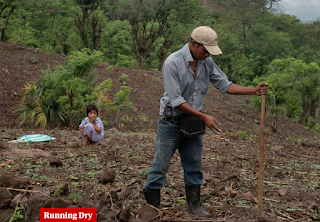
Recurring droughts in parts of Central America and the African Sahel in recent years have triggered migration as subsistence farmers, whose harvests have been decimated by low rainfall, seek refuge and jobs in other countries.
One key to tackling water scarcity is boosting investment in more sparing use of water in agriculture, an industry that absorbs more than two-thirds of the water used by people each year, the experts said.

News outlets continue to ignore climate change in articles about California's record-breaking weather (excerpt): Heated

"Nothing to see here, folks

This long weekend was literal hell for millions in the American West. California, Nevada, Arizona, Oregon, and Washington are suffering from dangerous heat, wildfire and smoke unlike anything they’ve ever seen. 

Three major newspaper stories. Zero climate mentions.
Californian Wildfires, 2019


Scientists attribute the unprecedented intensity of these events to human-caused climate change. Greenhouse gas emissions have made the atmosphere in these areas much hotter and drier than it used to be. “We’re living in a fundamentally climate-altered world,” MIT Technology Review noted last month, citing a multitude of peer-reviewed research about how climate change exacerbates extreme heat and wildfire. These so-called “compound climate events” are only predicted to get worse if greenhouse gas emissions continue unabated. 

Every American should be aware of these basic scientific facts when reading about the devastation of this weekend’s record-breaking extreme weather. But most of the major newspaper stories about the Labor Day Weekend from Hell don’t contain any climate-related information. Why?


Three major newspaper stories. Zero climate mentions.
Melting Siberian permafrost


Three major newspaper stories. Zero climate mentions.


Section A, page 12 of today’s New York Times contains a big story about the unprecedented weather pummeling California. Titled Extreme Heat Turns State Into a Furnace,” the piece contains more than 1,700 words of devastating detail about how heat, fire, and toxic air are affecting people in the state. But none of those details were about why things are getting so bad. None of those words were “climate change.”

The Associated Press’s article today is similar. Titled “Scorched earth: Record 2 million acres burned in California,” it contains 1,100 words about the weather’s unprecedented nature. It lists several different record-breaking data points, and quotes state officials saying how “unnerving” it is to have broken these records so early in the wildfire season. And yet this article—which will be re-published this morning in newspapers across the country—also does not mention the reason why these records might be happening.

The Washington Post also has an article about unprecedented
climate change-fueled extreme weather on its front page this
Three major newspaper stories. Zero climate mentions.
News coverage of Hurricane Laura analysed
morning, but it doesn’t mention climate change’s role. It’s about how 50 hikers are trapped inside a shelter within a rapidly-growing 130,000 acre wildfire, unable to be rescued. 

“This is one of the largest and most dangerous fires in the history of Fresno County,” the local fire chief said. “I don’t think everyone understands that.”

Newspapers often ignore basic climate science in extreme weather stories 


News outlets like the Times, the Post, and the AP have climate reporting teams. These teams all publish important stories about how the climate crisis fuels extreme weather across the country. The Times in particular has increased its climate coverage substantially in the last few years, according to data from the University of Colorado Boulder."


 Related: Trump and Biden: Little room for climate change in US election (excerpt): DW
 
role of media, journalists, #California, #wildfire, #bushfires, permafrost, hurricanes, cyclones, #jailclimatecriminals,


Tuesday, 8 September 2020

The Federal Government’s plan to use clean money to fund dirty projects - Video: The Climate Council

The Federal Government wants to use Australia’s clean energy bank to fund dirty fossil fuel projects. 

Yes, you read that correctly. Australia doesn’t need any new polluting fossil fuels. Coal and gas are expensive, polluting and a bad public investment. Our Clean Jobs Plan shows we can create 76,000 jobs in the short term, while setting Australia up for the future and tackling long-term problems like climate change (which seems like a much better idea). 

Learn more: https://climc.nl/3hCA9uI


Related:  Trump will roll back more environmental regulations if reelected, says EPA chief: CNBC

Climate Council, #Australia, jobs, #renewables, PM Morrison, coal, #methanegas, #climatechange, 

Canada's Climate Action Rating by the 'Climate Action Tracker' (Excerpt)


At the Climate Action Tracker site countries are evaluated according to the sufficiency of climate action.
Check out your country at the site.

(Excerpt- Pics by this blog)


"At 2 Dec 2019     Rating: Insufficient"

"Canada continues with the incremental implementation of its Pan-Canadian Framework on Clean Growth and Climate, its overarching strategy for reducing emissions, adopted in 2016; often in the face of provincial pushback. The Government is implementing its coal-fired power plant phase-out, but it clearly needs to take more climate action, as emissions are projected to still be above 1990 levels beyond 2030, far from its Paris Agreement target and nowhere near a 1.5˚C-compatible pathway.

Large enough to be seen from
 space, tailings ponds in
 Alberta’s oil sands region
National Geographic
The federal government had been facing strong headwinds against climate action at the provincial level, with four provinces (Saskatchewan, Manitoba, Ontario, and New Brunswick) challenging the constitutionality of its mandatory federal carbon pricing system. These provinces have no - or insufficient - climate plans and the carbon pricing system applies to them while these court challenges proceed. The first of the cases was recently decided in favour of the federal government and will now be appealed to the highest court in the country, the Supreme Court.

The headwinds reached gale force in April with the election of a conservative government in Alberta. The new government has already begun rolling back the province’s climate policy, while the federal government has stated that it will apply the federal carbon pricing ‘backstop’ to Alberta as well.