Wednesday, 9 September 2020

Water wars: How conflicts over resources are set to rise amid climate change: World Economic Forum

global warming is increasing competition for water around the world
Water shortages for one in four children in areas of extreme water shortage by 2040

   • From erratic rainfall to severe droughts, global warming is increasing competition for water around the world, with water-related conflicts on the rise.
 
  • According to the WRI, more than two billion people live in countries experiencing "high" water stress.
 
  • Conserving forests, wetlands and watersheds, including those around cities, can help absorb rainfall, helping stem crop losses from flooding and drought.

From Yemen to India, and parts of Central America to the African Sahel, about a quarter of the world's people face extreme water shortages that are fueling conflict, social unrest and migration, water experts said on Wednesday.
With the world's population rising and climate change bringing more erratic rainfall, including severe droughts, competition for scarcer water is growing, they said, with serious consequences.
"If there is no water, people will start to move. If there is no water, politicians are going to try and get their hands on it and they might start to fight over it," warned Kitty van der Heijden, head of international cooperation at the Netherlands' foreign ministry.


global warming is increasing competition for water around the world
Map of baseline water stress for countries

One in four children worldwide will be living in areas of extremely high water stress by 2040, researchers estimated.

"It's threats like these that keep me up at night," the diplomat told a webinar hosted by the World Resources Institute (WRI), a U.S.-based research group.
global warming is increasing competition for water around the world
African boy gathering muddy water


 According to the WRI, 17 countries face "extremely high" levels of water stress, while more than two billion people live in countries experiencing "high" water stress.

In terms of water availability, "at some point we are going to hit the wall, and that wall might be different in different places", Heijden said.

Climate change is compounding the challenge, she said, with cities such as India's Chennai and South Africa's Cape Town battling severe water shortages in recent years related in part to erratic rainfall.
Disputes over water have for millenia served as a flashpoint, driving political instability and conflict, the water experts said.
And "the risks of water-related disputes are growing .. in part because of growing scarcity over water", said Peter Gleick, co-founder of the California-based Pacific Institute, which jointly published the report with WRI and The Water, Peace and Security Partnership.
global warming is increasing competition for water around the world
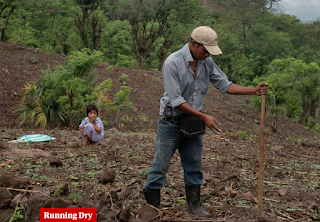
Drought affecting Central American farming
But as water scarcity grows, water systems are also increasingly becoming targets in other types of conflicts, said Gleick, whose institute has compiled a chronology of water conflicts that dates back 5,000 years.
In Yemen, years of fighting has destroyed water infrastructure, leaving millions without safe water to drink or grow crops. Wells and other water facilities also have been targets in Somalia, Iraq, Syria and other countries, he said.
Smarter irrigation
Climate change is compounding the challenge
India is already hot
Recurring droughts in parts of Central America and the African Sahel in recent years have triggered migration as subsistence farmers, whose harvests have been decimated by low rainfall, seek refuge and jobs in other countries.
One key to tackling water scarcity is boosting investment in more sparing use of water in agriculture, an industry that absorbs more than two-thirds of the water used by people each year, the experts said.

News outlets continue to ignore climate change in articles about California's record-breaking weather (excerpt): Heated

"Nothing to see here, folks

This long weekend was literal hell for millions in the American West. California, Nevada, Arizona, Oregon, and Washington are suffering from dangerous heat, wildfire and smoke unlike anything they’ve ever seen. 

Three major newspaper stories. Zero climate mentions.
Californian Wildfires, 2019


Scientists attribute the unprecedented intensity of these events to human-caused climate change. Greenhouse gas emissions have made the atmosphere in these areas much hotter and drier than it used to be. “We’re living in a fundamentally climate-altered world,” MIT Technology Review noted last month, citing a multitude of peer-reviewed research about how climate change exacerbates extreme heat and wildfire. These so-called “compound climate events” are only predicted to get worse if greenhouse gas emissions continue unabated. 

Every American should be aware of these basic scientific facts when reading about the devastation of this weekend’s record-breaking extreme weather. But most of the major newspaper stories about the Labor Day Weekend from Hell don’t contain any climate-related information. Why?


Three major newspaper stories. Zero climate mentions.
Melting Siberian permafrost


Three major newspaper stories. Zero climate mentions.


Section A, page 12 of today’s New York Times contains a big story about the unprecedented weather pummeling California. Titled Extreme Heat Turns State Into a Furnace,” the piece contains more than 1,700 words of devastating detail about how heat, fire, and toxic air are affecting people in the state. But none of those details were about why things are getting so bad. None of those words were “climate change.”

The Associated Press’s article today is similar. Titled “Scorched earth: Record 2 million acres burned in California,” it contains 1,100 words about the weather’s unprecedented nature. It lists several different record-breaking data points, and quotes state officials saying how “unnerving” it is to have broken these records so early in the wildfire season. And yet this article—which will be re-published this morning in newspapers across the country—also does not mention the reason why these records might be happening.

The Washington Post also has an article about unprecedented
climate change-fueled extreme weather on its front page this
Three major newspaper stories. Zero climate mentions.
News coverage of Hurricane Laura analysed
morning, but it doesn’t mention climate change’s role. It’s about how 50 hikers are trapped inside a shelter within a rapidly-growing 130,000 acre wildfire, unable to be rescued. 

“This is one of the largest and most dangerous fires in the history of Fresno County,” the local fire chief said. “I don’t think everyone understands that.”

Newspapers often ignore basic climate science in extreme weather stories 


News outlets like the Times, the Post, and the AP have climate reporting teams. These teams all publish important stories about how the climate crisis fuels extreme weather across the country. The Times in particular has increased its climate coverage substantially in the last few years, according to data from the University of Colorado Boulder."


 Related: Trump and Biden: Little room for climate change in US election (excerpt): DW
 
role of media, journalists, #California, #wildfire, #bushfires, permafrost, hurricanes, cyclones, #jailclimatecriminals,


Tuesday, 8 September 2020

The Federal Government’s plan to use clean money to fund dirty projects - Video: The Climate Council

The Federal Government wants to use Australia’s clean energy bank to fund dirty fossil fuel projects. 

Yes, you read that correctly. Australia doesn’t need any new polluting fossil fuels. Coal and gas are expensive, polluting and a bad public investment. Our Clean Jobs Plan shows we can create 76,000 jobs in the short term, while setting Australia up for the future and tackling long-term problems like climate change (which seems like a much better idea). 

Learn more: https://climc.nl/3hCA9uI


Related:  Trump will roll back more environmental regulations if reelected, says EPA chief: CNBC

Climate Council, #Australia, jobs, #renewables, PM Morrison, coal, #methanegas, #climatechange, 

Canada's Climate Action Rating by the 'Climate Action Tracker' (Excerpt)


At the Climate Action Tracker site countries are evaluated according to the sufficiency of climate action.
Check out your country at the site.

(Excerpt- Pics by this blog)


"At 2 Dec 2019     Rating: Insufficient"

"Canada continues with the incremental implementation of its Pan-Canadian Framework on Clean Growth and Climate, its overarching strategy for reducing emissions, adopted in 2016; often in the face of provincial pushback. The Government is implementing its coal-fired power plant phase-out, but it clearly needs to take more climate action, as emissions are projected to still be above 1990 levels beyond 2030, far from its Paris Agreement target and nowhere near a 1.5˚C-compatible pathway.

Large enough to be seen from
 space, tailings ponds in
 Alberta’s oil sands region
National Geographic
The federal government had been facing strong headwinds against climate action at the provincial level, with four provinces (Saskatchewan, Manitoba, Ontario, and New Brunswick) challenging the constitutionality of its mandatory federal carbon pricing system. These provinces have no - or insufficient - climate plans and the carbon pricing system applies to them while these court challenges proceed. The first of the cases was recently decided in favour of the federal government and will now be appealed to the highest court in the country, the Supreme Court.

The headwinds reached gale force in April with the election of a conservative government in Alberta. The new government has already begun rolling back the province’s climate policy, while the federal government has stated that it will apply the federal carbon pricing ‘backstop’ to Alberta as well.

South Africa's Climate Action Rating by the 'Climate Action Tracker' (Excerpt)

At the Climate Action Tracker site countries are evaluated according to the sufficiency of climate action.
Check out your country at the site.

(Excerpt- Pics by this blog)

"At 2 Dec 2019     Rating: Highly Insufficient"

"The South African government finally approved its Integrated

Resource Plan (IRP2019) in October 2019, confirming the trend change in power sector planning indicated in the draft for comment from August 2018. The plan reduces the role of coal compared to previous planning and increases the adoption of renewables and gas. Unlike earlier drafts, the IRP2019 proposes extending the operational lifetime of South Africa’s sole nuclear power plant by 20 years, up to 2044.

The final plan marks a major shift in energy policy, which is remarkable for a coal-dominated country like South Africa. It aims to decommission over 35 GW (of 42 GW currently operating) of coal-fired power capacity from state-owned coal and utility giant Eskom by 2050.

remarkable for a coal-dominated country like South Africa.
Coal in South Africa - Wikipedia
However, it would still see South Africa complete nearly 6 GW of costly coal capacity currently under construction and commission another 1.5 GW of new coal capacity by 2030. IRP2019 includes a detailed phase-out plan for coal-fired power plants, which, despite improvements to earlier plans, still shows that substantial amounts of coal capacity will run beyond the year 2050. For Paris-compatibility, coal must be phased out globally, at the very latest by 2040.

The plan also proposes a significant increase in renewables-based generation from wind and solar as well as gas-based generation capacity by 2030 (an additional 15.8 GW for wind, 7.4 GW for solar and 2.5 GW for gas by 2030), with no further new nuclear capacity being procured.

Implementing the IRP2019 will enable South Africa to achieve its 2030 NDC target. However, we rate South Africa’s NDC target as “Highly Insufficient” based on the upper end of the NDC range. In this context, South Africa should consider revising its target downward for 2030 to be resubmitted to the UNFCCC as part of the Paris Agreement’s ambition raising cycle of 2020.

To be in line with the Paris Agreement goals, South Africa would need to adopt more ambitious actions by 2050 beyond the IRP2019, such as even further increasing renewable energy capacity by 2030 and beyond, fully phasing out coal-fired power generation by latest 2040, and substantially limiting natural gas use.

Although South Africa is one of the few countries that has put forward absolute emissions targets in their NDC, we still rate this target “Highly Insufficient”.  ..........................


Go to Climate Action Tracker for more detail.

Related: This is what sea level rise will do to coastal cities: Video


...and in Australia: "While the federal government continues to repeatedly state that Australia is on track to meet its 2030 target “in a canter”, the Climate Action Tracker is not aware of any scientific basis, published by any analyst or government agency, that would support this. The OECD has warned the Australian Government that it will not achieve its target without intensified mitigation efforts. It describes current climate policy as a “piecemeal approach”." Climate Action Tracker

#climateaction, coal mining, South Africa, Paris Agreement, Paris Targets, #renewables,

Monday, 7 September 2020

Climate Change Poses Serious Threats to India's Food Security (excerpt): The Wire

Climatic factors like increased temperatures and extreme rainfall will affect productivity by causing physiological changes. Photo: Reuters
"Planning for the long-term impacts of climate change on agriculture appears to be rather low on the government's priority list.

Issues including the security clampdown in the Valley and slowdown in major sectors of the economy are dominating headlines. The agriculture ministry too would be occupied with formulating interventions to spur the economy of the erstwhile state of Jammu and Kashmir.


Climate change is no longer a distant threat. According to the Indian Meteorological Department, the annual mean temperature in the country has increased by 0.6 degrees Celsius between 1901 and 2018, when compared to pre-industrial levels. Eleven of the 15 warmest years have so far all been within the last 15 years with 2018 being the sixth warmest year in India’s recorded history.

The extent and degree of warming are going to get more severe. As carbon emissions continue and those which are built into the climate system take effect, temperatures across the world are expected to increase between 3-5 degree Celsius by 2100. India is among the countries which are likely to bear the worst of a warming planet due to its tropical location and relatively lower levels of income.

Agriculture and food production are likely to be significantly affected by climate change. According to one estimate, yields of major crops could decline by up to 25%. A recent IPCC report also warned that in the years to come, food security will stand threatened due to climate change coupled with increasing demands of the rising population.

The global population is expected to increase from 7.7 billion in 2019 to 8.5 billion by 2030 and 9.7 billion by 2050. According to the United Nation’s World Population Prospects (June 2019), the Indian population is projected to increase from 1.36 billion in 2019 to 1.5 billion by 2030 and 1.64 billion by 2050.

Crops, animal husbandry, as well as fisheries,
 are likely to be impacted. Photo: Reuters

Providing food and nutritional security to an entire population needs some serious planning and effective implementation. And we need to start now. 

Climatic factors like increased temperatures and extreme rainfall will affect productivity by causing physiological changes. In addition, they will affect soil fertility, the incidence of pest infestation and the availability of water. This will impact crops, animal husbandry as well as fisheries."................................

From The Wire 
by Siraj Hussain
19/Sep/2019

Book: What Can I Do? by Jane Fonda: ‘If Greta Thunberg can do it, so can I’ (excerpt): The Guardian

the actor recalls the beginnings of her climate crisis protests outside the White House
Jane Fonda, actor and climate activist
"There was a long silence, and then she said, “Well, Jane, that’s wonderful and I’m blown away that you’re ready to put yourself out there like that, but you can’t camp overnight in Washington. It’s illegal since Occupy Wall Street camped there. But let’s figure out what is possible.” She offered to set up a conference call with her, Bill McKibben, co-founder of 350.org, Naomi Klein, the environmental lawyer Jay Halfon, and me. Bill suggested a once-a-week protest that involved civil disobedience. Fridays had been claimed by Greta Thunberg and the student climate strikers, but the youth had also called on adults to join them. “Maybe you could do an action on Fridays as well.”

I’d been getting ready for this my whole adult life – a weekly
An extract from Jane Fonda's book
Jane Fonda climate activist
action that culminated in nonviolent civil disobedience. And I wouldn’t have to worry about pooping. I began planning for the maximum time I could spend in DC before I had to get ready to film our last season of Grace And Frankie on 27 January 2020. It added up to four months, 14 Fridays."


What Can I Do? by Jane Fonda is published by HQ, at £20. To order a copy for £17.40, go to guardianbookshop.com. Delivery charges may apply.
 

Go to The Guardian's article 

Related: 'The Future We Choose', Book by Christiana Figueres & Tom Rivett-Carnac